Wednesday, 26 August 2015

CHOICE

Choice

Someone in my whatssapp group asked this question, “Humanism and Human thought, which in your opinion prevails?”

My answer to this was, “Humanism is weaning owing to greed and Human thought is obsessed with greed. Even the concept of divinity is pawned towards the fulfillment of greed. Ironically statistics have shown that more people today belong to one religion or the other compared to about 50 years ago. Well this in accordance to what has been prophesized to happen the in Kali Yuga. Prophecy or not, humans have the mental faculty for reasoning, as such how they use it, is up to the beholder. Either way it is a CHOICE that one make.”

That made me to think…..do we really have CHOICE in life?

Choice can be defined as the ability to voluntarily select from an array of options available or created by the beholder.

That brings to mind Glasser’s theory of choice, which states that human choices are motivated by 5 basic needs, to love and belong, to be powerful, to be free, to have fun, and to survive. However Glasser expounds that these five needs are further influenced by Human Basic Needs (Nature), Quality of the World (Nurture), Reality and Perception (Sensory, Knowledge & Value), Comparing Place (matching what we perceive and what we want), and Total Behaviour (Acting, Thinking. Feeling & Physiology).

In a nutshell what it all means is, the choices we make are very much an externalized outcome. Although Glasser’s theory propounds that human behavior is an outcome based on in internal motivation yet it all connects to an external source nevertheless. So although we can claim that we can technically control our own behavior but in actual sense its merely a manifestation of externalities.

In the Vedanta philosophy the focus is given to the process of knowledge whereby it has categorized six means in the process known as Pramanas. It includes Pratyaksha (Perception), Anumana (Inference), Upamana (Comparison), Arthapatti (Postulation), Anupalabdhi (Non-apprehension), and Sabda (Verbal Testimony). According to the Vedanta philosophy these six valid means of knowledge consciously or unconsciously affects our thought process and influences our behavior in our day to day life which also includes our choice as we know. However one must understand that the emphasis of the Vedanta on the six Pramanas is focused on one’s spiritual journey of self-discovery.

So whether it’s material pursuit or spiritual pursuit the choice we make is the choice of the pathway to realize ones goals. Some may choose the most convenient or popular way and others maybe more adventurous. Which reminded me of a poem by Robert Frost, “The Road Not Taken.”


The Road Not Taken

Two roads diverged in a yellow wood,
And sorry I could not travel both
And be one traveler, long I stood
And looked down one as far as I could
To where it bent in the undergrowth;

Then took the other, as just as fair,
And having perhaps the better claim,
Because it was grassy and wanted wear;
Though as for that the passing there
Had worn them really about the same,

And both that morning equally lay
In leaves no step had trodden black.
Oh, I kept the first for another day!
Yet knowing how way leads on to way,
I doubted if I should ever come back.

I shall be telling this with a sigh
Somewhere ages and ages hence:
Two roads diverged in a wood, and I—
I took the one less traveled by,
And that has made all the difference.” 
by Robert Frost

I would personally hold to a principle that “one should know what they don’t know”, only then the pathway of his/her journey becomes constructive and meaningful.

by

ravivarmman@26082015

Tuesday, 11 August 2015

Your BIRTH could have been an incident but Your DEATH should be HISTORY.

Your BIRTH could have been an incident but Your DEATH should be HISTORY.

I was inspired to pen down my thoughts upon the death of APJ Abdul Kalam recently.

It has been a while since I last wrote on my blog. “Busy” would be an excuse, but more so I was not motivated to write. Why? Perhaps too many things were happening that did not allow space in my faculty to reflect.

Upon the demise of the former President, Statesman, Scientist and more importantly a humble down- to- earth human being, Avul Pakir Jainulabdeen Abdul Kalam, the accolades that still continue to flow kept bouncing in my thoughts.

The only thing that can be spoken of with absolute certainty about LIFE is DEATH. Beyond death it is subject to many ideologies, but what maketh a man is measured by his/her life from birth to death.

I always find it very amusing during funerals, where people actually search deep down to say something nice about the deceased, even though while the person was alive nothing positive could have been said. If only participants see the good in each other and work towards establishing cordiality, the world would be a better place to live. Alas all is not that rosy, idealism is one thing but reality may have  sallow consequences.

Whilst the rest of the world is caught up in the rat race, comes along a soul like Kalam, who seems to be least perturbed by the ever evolving imperious social construct that governs many of human actions.

Kalam’s rise from an impoverished background to an eventual adieu as a Statesman could feed the screenplay for a typical Bollywood movie, but on the contrary it may not, because Kalam was not the typical hero that everyone envisions. From his humble beginnings to his meteoric rise as a scientist, Kalam lived his life in his own terms, never flinching to the call of socio-behavioral entrapment that comes with success. Kalam believed in the power of oneself, always seeking inspiration internally rather than externally. It reminds me of one of Kalam’s quotes, “You cannot change your future, but you can change your habits, and surely your habits will change your future.”

This reminds me of a colleague whom I bumped into yesterday, who asked me this question, “how are you able to look so young?”

I said, “Be happy.” And he said “that is the problem - how?” My answer to that question was, “realize that you are not in control of anything that happens around you. We are living in a world of probability, where every logical, rational, or even emotional action we take only differs in the degree to which the desired outcome may be achieved. The only thing that we “can be” in control of is our mind and mind-set. So how one perceives life is up to the beholder, detaching oneself from the burden of creation would be the first step. Seek happiness within, and not outside, for the external happiness is totally insatiable and you will never be in control of it, and that adds to your misery.”

Kalam also said, “no matter what is the environment around you, it is always possible to maintain your brand of integrity,” and he was a man who lived this to his last breath. So when somebody says it can’t be done, well, Kalam was living proof.

“All birds find shelter during a rain. But eagle avoids rain by flying above the clouds. Problems are common but attitude makes the difference,” Kalam once said in his speech. 

A man charts history only with the right attitude, which comes from within.

So one’s mindset is essential in shaping one’s thoughts and actions. To be successful is easy but to sustain success is often a problem that many face. To that Kalam says, “A fool can become a genius when he understands he is a fool, but a genius can become a fool when he understands he is a genius.” Kalam’s rooted outlook kept his humanity intact despite his achievements.

Beyond his knowledge, skills and statesmanship, Kalam had a good sense of humor. His former colleague at ISRO (Indian Space Research Organization), Nambi Narayanan narrated, “The greatness of the man was his intellectual honesty. In one of our recent interactions, I told Kalam that he might not find everything in my upcoming book flattering. He said, ‘Then I will write the preface.’ " (excerpt from TOI)

Reflecting on Kalam’s journey called life, we have much to learn and put in practice. He carved a milestone in the minds of some but touched the hearts of many more. He stands tall as an inspiration to all.

Goodbye Guru Kalam,
Gone But Will Never Be Forgotten.
A Man Who Made History,
And a Man Who is History Himself.


A tribute to APJ Abdul Kalam (1931-2015)

By
Ravi Varmman Kanniappan

10 August 2015

Tuesday, 3 February 2015

THIRUCHENDOOR MURUGAN TEMPLE, THIRUCHENDUR, TUTICORIN, TAMIL NADU


THIRUCHENDUR TEMPLE, THIRUCHENDUR, TUTICORIN, TAMIL NADU.

In conjunction with Thaipoosam I would like to write about Tiruchendur Murugan temple which is also the second Arupadai Veedu of Lord Muruga. It is written in the Puranas that Lord Muruga won the battle with the Asura (demon), Surapadma and worshipped Lord Shiva in this sacred place. The Thiruchendur temple is situated along the shores of the Bay of Bengal, about 20 kilometers from Tuticorin (Thoothukudi) in Tamil Nadu.

The architecture of this temple is different from other South Indian Temples where the main Gopuram (Raja Gopuram) is in the East, whereas in Thiruchendur Temple the Gopuram is in the West. This is due to the fact that the eastern side is close to the sea. Further this is the only temple in TN where the inner sanctum sanctorium is below the ground level. It is believed that the temple was originally a rock cut structure, cut from the Chandana Hills, and later the temple was renovated with granite.

Although the shrine is of ancient origin, much of the structure here is from the 19th through the 20th centuries. Inscriptions from the 9th century Pandya rulers are seen in the temple.

This temple has been in existence for millennia, according to the Puranas. Thiruchendur is merely a Tamil name given to this site due to the abundance of sandalwood. It is also known as Sri Jayantipura in the scriptures. There is an expectional tradition of adhering to the Kumara Tantra instead of the Saiva Agamas, which makes this temple an exclusively Kaumara shrine. Even with the growing prominence of Saivism,  this temple has still managed to resist the introduction of the Saiva Agamas.
The form of Lord Murugan in this temple has also been extensively described in the Kumara Tantra. The Kumara Tantra describes the Lord of Sri Jayantipuram (Lord Senthilnathan or Lord Murugan) to wield a Shakti (lance),  Akshmala(rosary), Katibaddha (one hand resting on His hip) and Ambhuja (lotus).

An interesting fact about this temple was that this temple totally escaped from the onslaught of tsunami of 2004. Eye witness, including somebody I know personally who was there at the temple during the tsunami incident, actually saw the sea rising but apparently it never hit the shore near the temple where they were standing at the beach.


Amazing temple by the beach, with a picturesque scenery.

Next time in TN don’t forget to visit this temple.

Source: various

photo@ravivarmman092013

Wednesday, 20 August 2014

I AM ..........................???

Who Am I?

One day a professor went to see Ramana Maharshi and asked him, "Can you help me to see GOD?"

Ramana asked the professor, "who are you, why do you want to see GOD?"

"I am Devadutt Sharma", exclaimed the professor.

"That is your name, but who are you?" asked Ramana.

"I am an Anthanan," said the professor.

"That is your hereditary, but who are you?" Ramana asked again.

"I am a college professor," proudly said the professor.

"That is your profession, but who are you?" Ramana went on further.

"I am a man," said the professor, getting a little frustrated.

"That is your gender by birth, so who are you anyway?" nudged Ramana.

The professor finally said, "I really do not know who I am then."

Ramana replied, " You don't even know who you are to begin with, and how do you think you will ever know GOD."

"Self-discovery is the first step in the journey towards attaining higher level of consciousness of spiritual realization."

Unfortunately for many, the search is for quick fixes to their worldly problems. A miracle is what everyone wants. Divinity has been hijacked by giving it a generic term called GOD and have been given multiple brand names via RELIGION. As human life becomes more intertwined, so have complexities in leading our lives. Brand religion became popular by providing convenient solutions to the UNKNOWN.

FAITH and HOPE have become the buzz words in selling GOD. So GOD became the granter of wishes to mortal souls. But we have been taught to believe that nothing is free in this world.  I guess that applies to GOD as well. So how would GOD grant our wishes? Well we have to give something to GOD in return for HIS/HER blessings. By the way by now Divinity has also been given a gender. Convenient isn't it? Thereupon a dogma is constructed around this concept to provide for a structure to attain GOD's blessings. So goes the practice of undivided conformity to rituals and prayers. But often in a hurried world today, even that is found to be a little tedious and time consuming.

Enter the Places of Worship or Godmen or Holyman or Evangelist or Shaman who becomes GOD's agent and who can connect one directly to GOD. But of course there is a price to be paid - often large material contributions to the coffers of these places of worship or middleman, all  in the name of donation.

An example to quote, the world’s richest place of worship would be the Thirupathi Venkateshwara Temple. It is said that the temple is estimated at a worth of USD8billion, with a daily collection of donations amounting to about USD700K. That is just a glimpse of the level of desperation people have in hoping for that 'miracle' which would change their entire life. Of course this temple runs multiple charitable activities which includes schools, colleges, hospitals etc. However it can't be said that all places of worship have similar agendas. Interestingly it is also reported that there are places of worship in Pakistan that not only harbor, but also promote undesirable anti-social activities.

From a Godmen perspective, TeleEvengelist Chris Oyakhilome of the Christ Embassy, is estimated to be worth USD50million. He was implicated in USD35million money laundering activities which he was later cleared of. Or for that matter the infamous Swami Nithyananda of India who was implicated in a sex tape scandal. Regardless, the irony is that the faithful are unperturbed by all these, as they merely treat these as minor distractions in their quest for higher callings i.e. 'miracles'.

Desperation and faith are a powerful concoction that has potent results. Militants preparing to be martyrs, are often found to be individuals who come from disadvantaged or even a psychological scarred strata of society. Martyrdom promises paradise in afterlife. For some it could be a way out from a wretched life that they are already living.

Whether one is sitting for an examination, going for an interview, in financial difficulty or facing any other life challenge, everyone seeks a 'miracle'. Even a glimmer of hope of a quick fix from GOD or Godmen would entice human imagination.

Funnily enough, in all these desperate attempts, humans seem to externalize their search for satisfaction or redemption, never once looking inward in search of the answer.

Instead of looking for the elusive GOD in the heavens, perhaps people should start looking within oneself to find the answer.

"Brahman is supreme; he is self-luminous, he is beyond all thought. Subtler than the subtlest is he, farther than the farthest, nearer than the nearest. He resides in the lotus of the heart of every being." Mudaka Upanishad 3:1:7.

"What? Know ye not that your body is the temple of the Holy Ghost in you, which ye have of God, and ye are not your own." Corinthians 6:19-20

Both the above have been quoted from the respective holy books, and both belief systems prescribe to the same philosophy, but where did they fail?

The failure was human GREED. Greed commoditized everything, including DIVINITY. In a world filled with the expectation for instant gratification, spirituality has lost its relevance. Spirituality is often confused with the act of devotion and prayer, for it is only a precursor towards a journey of self -realization and it is not the end itself.

But first we have to find the humanity within us. We should stop the attitude of "expecting to be a receiver" and start becoming a "giver without expectations".

OM TAT SAT.   

ravivarmman21082014

Sunday, 17 August 2014

THE HIDDEN TEMPLE SERIES 1 : PARAMESWARA VINNAGARAM TEMPLE, KANCHEEPURAM, TAMIL NADU

VAIKUNDA PERUMAL TEMPLE, KANCHEEPURAM, TAMIL NADU.
(aka PARAMESWARA VINNAGARAM TEMPLE)


Parameswara Vinnagaram or Vaikunta Perumal Temple is a temple dedicated to the Hindu god Vishnu, located in Kancheepuram in the South Indian state of Tamil Nadu. The temple is believed to have been built by the Pallava King Nandivarman II (720-96 CE), with later contributions from Medieval Cholas and Vijayanagar Kings.


The great Vaishnava saint Thirumangai Alvar was his contemporary. This temple is revered in Nalayira Divya Prabandham, the 7th–9th century Vaishnava canon by Thirumangai Alvar in 10 hymns. The temple is classified as a Divyadesam, one of the 108 Vishnu temples that are mentioned in the Vaishnava canon. The temple is one of the fourteen Divyadesams located in Kanchipuram and is part of Vishnu Kanchi, the place where most of the Vishnu temples in Kancheepuram are located.

Like other Vishnu temples of Tamil Nadu, the priests belong to the Vaishnavaite community.  The Vaikasi Brahmotsavam, celebrated during the Tamil month of Vaikasi (May-June), and Vaikunta Ekadashi celebrated during the Tamil month of Margazhi (December-January) are the two major festivals celebrated in the temple.

Vaikuntha Perumal temple was first built with a distinctive style in South India.  The walls of this temple are adorned  with religious sculptures. Further, the inner wall of the verandah running around the four sides of this temple, has a series of Pallava Dynasty history sculptured on it, up to the reign of Nandivarman II Pallavamalla (builder of the temple). 


Nandivarman II came to the throne at the age of twelve in c. AD 731-32. He ruled for nearly 65 years and it was an important era in Pallava history. His relations with the Chalukyas, the Rashtrakutas and the Pandyas were varied, and at times hostile, at times peaceful. Nandivarman's reign is notable for the development of two conflicts one in the north with the Chalukyas, which is traditional, and the other in the south with the Pandyas which was later to have such fateful consequence in the battle of Tiruppurambiam.

One particular sculpture that stood out was of I Ching, the famous Tang Dynasty Buddhist monk, who traveled by sea to India and studied at Nalanda University for eleven years before returning with a collection of as many as 500,000 Sanskrit stanzas. He translated more than 60 sutras into Chinese, including Saravanabhava Vinaya , Avadana, and Suvarnaprabhascottamaraja-sutra. He is also responsible for the translation of eleven Buddhist tantras and eighteen works on monastic discipline, as well as exegetic works. I Ching travelled in India during the reign of King Narashimhavarmman II (aka Rajashimha) who is the father of King Parameswaravarmman II, whom Nandivarmman II inherited the Kingdom from.


One of the main attractions of Vaikuntha Perumal temples is the exceptional 1000 paired hall.  The extra characteristic about it is that each pillar has a statue carved on it.  Inside the temple, lion pillars support the enclosed passages and the architecture of the temple has played a vital role in the architectural evolution of the grand thousand pillared mandaps (halls) built-in the later South Indian temples.  On the wall of the temple there are several inscriptions related to the wars between the Pallavas and Chalukyas.


One interesting phenomena here is the Nawab Sathathullah Khan Mosque which was built by the Nawab of Arcot who ruled the Carnatic territory under the patronage of the Mughals located next door to this temple.   Interestingly the temple shares its water source from a tank for more than 300 years with the mosque. The beauty is that Moslems participate in the Brahmatvasam festivals of the temple every year.


The Nawabdom of the Carnatic was established by the Mughal emperor Aurangzeb in 1692 AD. With the Vijayanagara Empire in serious decline, the Nawabdom of the Carnatic controlled a vast territory south of the Krishna river. The Nawab Saadatullah Khan (1710-1732 AD) moved his court from Gingee to Arcot. Muhammed Ali Khan Wallajah (1749 - 1795) was freed from his suzerainty and made the independent ruler of the Carnatic by the Mughal emperor in 1765. His rule was long and mostly peaceful. He donated generously to Churches, Temples and Mosques. The temple at Sri Rangam was one which benefited from his generosity.

The thirteenth Nawab, Ghulam Muhammad Ghouse Khan (1825–1855), died without issue and the British annexed the Carnatic Nawabdom applying the doctrine of lapse. Ghouse Khan's uncle Azim Jah was created the first Prince of Arcot (Amir-E-Arcot) in 1867 by Queen Victoria, and was given a tax free pension in perpetuity. This privilege continues to be honoured by the Government of India. This status is protected by the Indian Constitution and the family continues to retain its privileges and titles. The current Prince of Arcot Abdul Ali came to the title in July 1994.

Religious harmony was and still exists, in Kancheepuram.

Next time in Kancheepuram, TN, make sure you don’t miss this temple. The grandiose of its architecture and sculpture depicting the history of the Pallava Kingdom is truly mesmerizing and a feast to the eyes.

Source:various


photo@ravienavarmman&ravivarmman072014

Sunday, 3 August 2014

THE HIDDEN TEMPLE SERIES 1: Jurahareswarar (aka Iravanatheswara) Temple at Juragaresam


The main deity in this temple is Shiva in the form of linga known as Jurahareswarar.
Legend has that a demon called Juragan was destroyed here. Devas worshipped in this place to cure themselves from disease due to heat and they were cured. Therefore it is believed that those who worship Shiva here, is known to have been cured of ailments such as fever, relieving them from excessive body heat to maintain normal body temperature.

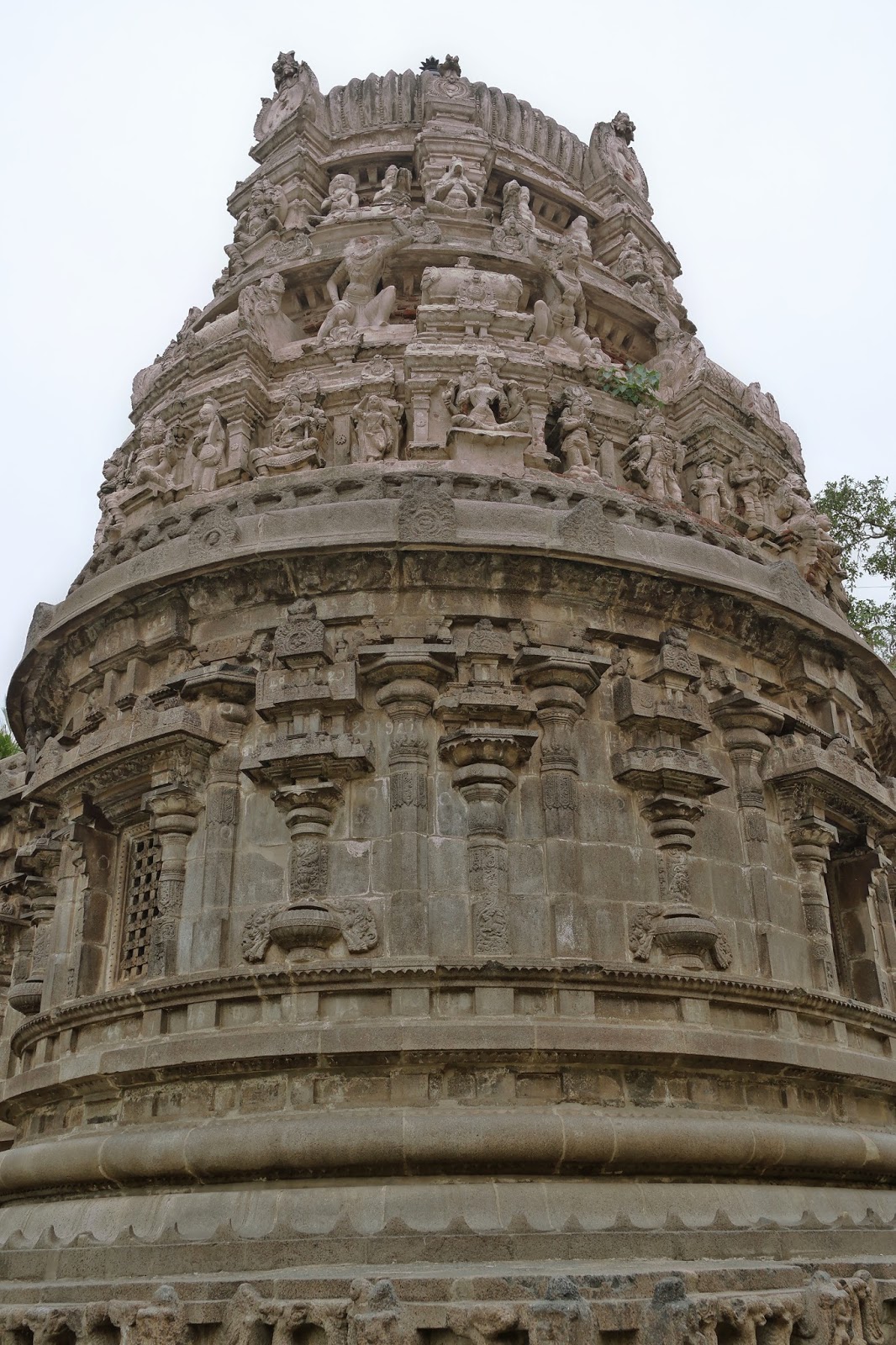
There are five windows in the sanctum sanctorum which in itself has a circular design. 

(a side view of the sanctorum)

(a view of the circular sanctorum)

(Intricate carvings on the main Gopuram)

(one of the 5 windows adorns the inner sanctum)

It is a magnificent example of Pallava architecture. The temple was built using both sandstone and granite and many figures are engraved on them.  The idol of Juvarahereswarar here is one of the 64 holy idols (formless form of Lord Shiva). There are two kinds of divine treasures in the temple. There is a statue of Lord Gubera (God of treasure) in this temple.

(Side view of the temple with the Nandi Sannidhi, Bali Peedam and the Upperi Kulam on the extreme right)

The temple tank is called ‘Vepperi Kulam’ and now is popularly known as ‘Upperi Kulam’ where the temple Theerthem (Holy water) is sourced.

This temple is famous for its splendid Vimana (deity's vehicle) Nandi (Bull). 

(the smiling Nandi)

This temple was built by Pallava King Narasimhavarman II (aka Rajasimhan) who ruled from 695.C.E-728.C.E.

Apart from Jurageswarar Temple, Narashimhavarman II was also instrumental in building the famous Kailasanathar Temple,  Vaikuntha Perumal Temple at Kanchipuram,  Shore Temple at Mahabalipuram and the Talagirisvara Temple at Panamalai.

The temple is located next to Pandava Thootha Perumal temple to the south of Sannidhi street of Sri Ekambareswarar temple, Kancheepuram, TN.

Most people do give this temple a miss for other famous temples in Kancheepuram, not realizing both its spiritual and historical significance.

Do visit this temple for its architectural marvel when you are in Kancheepuram, Tamil Nadu.

Currently this temple comes under the purview of ASI (Archeological Survey India)

photo@ravienavarmman072014

Tuesday, 15 July 2014

FLASHMOB IN CHENNAI


A flashmob at Express Avenue, Mall, Chennai. TN. India has joined the bandwagon of many Asian cities boasting of large "supermalls". There is a sudden surge of such Malls in Delhi, Mumbai, Bangalore, Chennai, Gurgaon, and even second tier cities in India has caught on with the "mall bug." 

I believe this is in line with the changing lifestyle of urban India. Education and exposure has created a new breed of generation in urban India. (not much different in modern taste and preference as similar generation elsewhere but the distinction is they are still deeply rooted in culture and tradition.

Interestingly I have also noticed that reading habit is still very much alive here than in other parts of Asia (particularly Malaysia.)

From Idli Vada to Pav Bhajji, has become hypp food all over India with the mushrooming of snack bars and chain restaurants giving a run for the money for other western style food.

There is no denial, that western themed restaurants are gaining popularity, but at this point it seems a healthy competition but not too sure what the future holds.

One of the overrated restaurant (at least I think so) the Hard Rock Cafe, has mushroomed in India, from the first restaurant in Mumbai (2006) it is now operating in all major metros in India. From my reading the patrons are primarily urban college students, IT professionals, celebrities etc. (Would be checking it out in Vellacherry, Chennai, end of the month, to obtain a first hand account).

Meanwhile the flashmob in this photo danced to the tune of "Lunggi Dance" in conjunction with the movie "Chennai Express" (SRK & Deepika P.)