Sunday, 17 August 2014

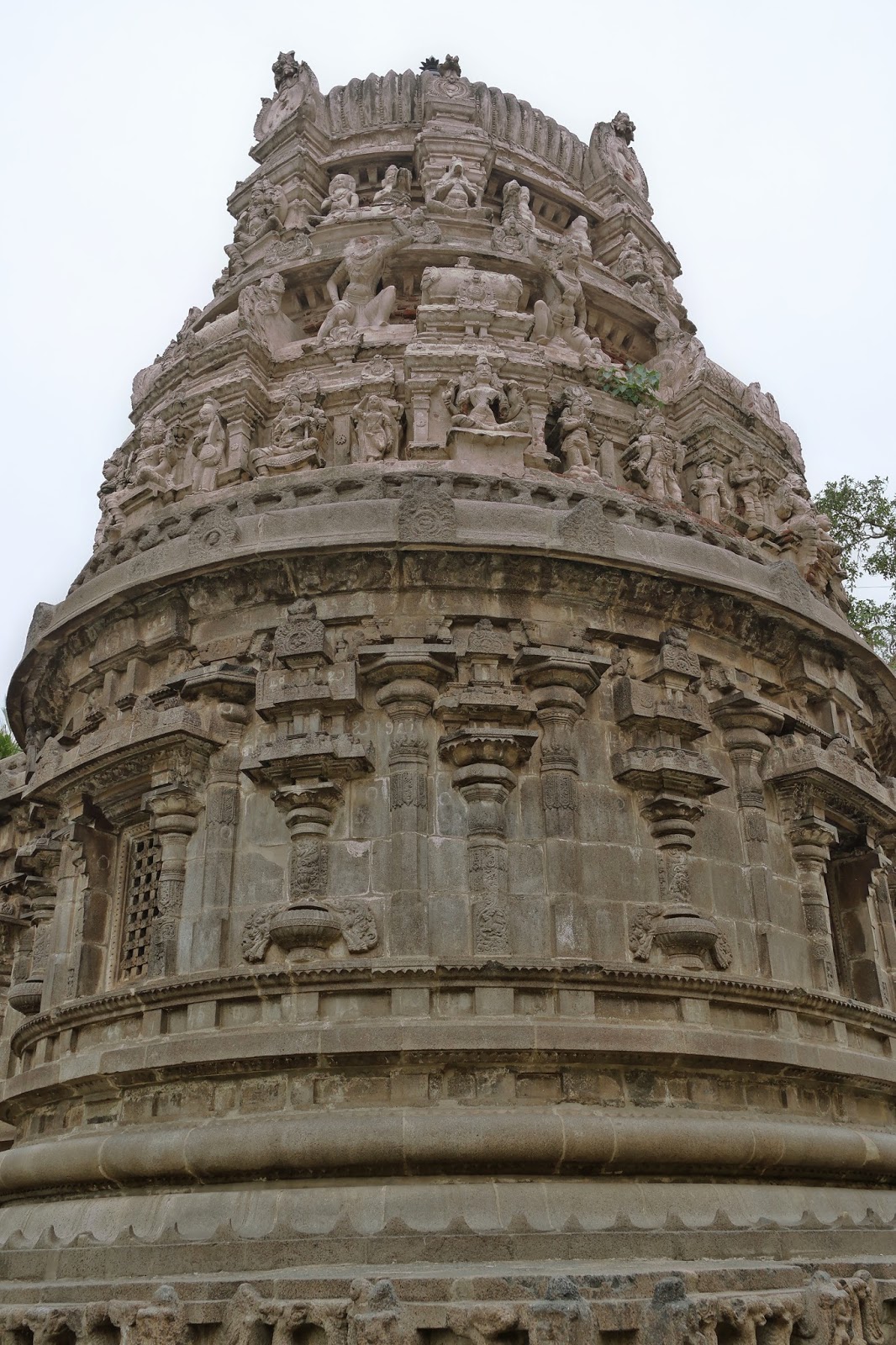
THE HIDDEN TEMPLE SERIES 1 : PARAMESWARA VINNAGARAM TEMPLE, KANCHEEPURAM, TAMIL NADU

VAIKUNDA PERUMAL TEMPLE, KANCHEEPURAM, TAMIL NADU.
(aka PARAMESWARA VINNAGARAM TEMPLE)


Parameswara Vinnagaram or Vaikunta Perumal Temple is a temple dedicated to the Hindu god Vishnu, located in Kancheepuram in the South Indian state of Tamil Nadu. The temple is believed to have been built by the Pallava King Nandivarman II (720-96 CE), with later contributions from Medieval Cholas and Vijayanagar Kings.


The great Vaishnava saint Thirumangai Alvar was his contemporary. This temple is revered in Nalayira Divya Prabandham, the 7th–9th century Vaishnava canon by Thirumangai Alvar in 10 hymns. The temple is classified as a Divyadesam, one of the 108 Vishnu temples that are mentioned in the Vaishnava canon. The temple is one of the fourteen Divyadesams located in Kanchipuram and is part of Vishnu Kanchi, the place where most of the Vishnu temples in Kancheepuram are located.

Like other Vishnu temples of Tamil Nadu, the priests belong to the Vaishnavaite community.  The Vaikasi Brahmotsavam, celebrated during the Tamil month of Vaikasi (May-June), and Vaikunta Ekadashi celebrated during the Tamil month of Margazhi (December-January) are the two major festivals celebrated in the temple.

Vaikuntha Perumal temple was first built with a distinctive style in South India.  The walls of this temple are adorned  with religious sculptures. Further, the inner wall of the verandah running around the four sides of this temple, has a series of Pallava Dynasty history sculptured on it, up to the reign of Nandivarman II Pallavamalla (builder of the temple). 


Nandivarman II came to the throne at the age of twelve in c. AD 731-32. He ruled for nearly 65 years and it was an important era in Pallava history. His relations with the Chalukyas, the Rashtrakutas and the Pandyas were varied, and at times hostile, at times peaceful. Nandivarman's reign is notable for the development of two conflicts one in the north with the Chalukyas, which is traditional, and the other in the south with the Pandyas which was later to have such fateful consequence in the battle of Tiruppurambiam.

One particular sculpture that stood out was of I Ching, the famous Tang Dynasty Buddhist monk, who traveled by sea to India and studied at Nalanda University for eleven years before returning with a collection of as many as 500,000 Sanskrit stanzas. He translated more than 60 sutras into Chinese, including Saravanabhava Vinaya , Avadana, and Suvarnaprabhascottamaraja-sutra. He is also responsible for the translation of eleven Buddhist tantras and eighteen works on monastic discipline, as well as exegetic works. I Ching travelled in India during the reign of King Narashimhavarmman II (aka Rajashimha) who is the father of King Parameswaravarmman II, whom Nandivarmman II inherited the Kingdom from.


One of the main attractions of Vaikuntha Perumal temples is the exceptional 1000 paired hall.  The extra characteristic about it is that each pillar has a statue carved on it.  Inside the temple, lion pillars support the enclosed passages and the architecture of the temple has played a vital role in the architectural evolution of the grand thousand pillared mandaps (halls) built-in the later South Indian temples.  On the wall of the temple there are several inscriptions related to the wars between the Pallavas and Chalukyas.


One interesting phenomena here is the Nawab Sathathullah Khan Mosque which was built by the Nawab of Arcot who ruled the Carnatic territory under the patronage of the Mughals located next door to this temple.   Interestingly the temple shares its water source from a tank for more than 300 years with the mosque. The beauty is that Moslems participate in the Brahmatvasam festivals of the temple every year.


The Nawabdom of the Carnatic was established by the Mughal emperor Aurangzeb in 1692 AD. With the Vijayanagara Empire in serious decline, the Nawabdom of the Carnatic controlled a vast territory south of the Krishna river. The Nawab Saadatullah Khan (1710-1732 AD) moved his court from Gingee to Arcot. Muhammed Ali Khan Wallajah (1749 - 1795) was freed from his suzerainty and made the independent ruler of the Carnatic by the Mughal emperor in 1765. His rule was long and mostly peaceful. He donated generously to Churches, Temples and Mosques. The temple at Sri Rangam was one which benefited from his generosity.

The thirteenth Nawab, Ghulam Muhammad Ghouse Khan (1825–1855), died without issue and the British annexed the Carnatic Nawabdom applying the doctrine of lapse. Ghouse Khan's uncle Azim Jah was created the first Prince of Arcot (Amir-E-Arcot) in 1867 by Queen Victoria, and was given a tax free pension in perpetuity. This privilege continues to be honoured by the Government of India. This status is protected by the Indian Constitution and the family continues to retain its privileges and titles. The current Prince of Arcot Abdul Ali came to the title in July 1994.

Religious harmony was and still exists, in Kancheepuram.

Next time in Kancheepuram, TN, make sure you don’t miss this temple. The grandiose of its architecture and sculpture depicting the history of the Pallava Kingdom is truly mesmerizing and a feast to the eyes.

Source:various


photo@ravienavarmman&ravivarmman072014

Sunday, 3 August 2014

THE HIDDEN TEMPLE SERIES 1: Jurahareswarar (aka Iravanatheswara) Temple at Juragaresam


The main deity in this temple is Shiva in the form of linga known as Jurahareswarar.
Legend has that a demon called Juragan was destroyed here. Devas worshipped in this place to cure themselves from disease due to heat and they were cured. Therefore it is believed that those who worship Shiva here, is known to have been cured of ailments such as fever, relieving them from excessive body heat to maintain normal body temperature.

There are five windows in the sanctum sanctorum which in itself has a circular design. 

(a side view of the sanctorum)

(a view of the circular sanctorum)

(Intricate carvings on the main Gopuram)

(one of the 5 windows adorns the inner sanctum)

It is a magnificent example of Pallava architecture. The temple was built using both sandstone and granite and many figures are engraved on them.  The idol of Juvarahereswarar here is one of the 64 holy idols (formless form of Lord Shiva). There are two kinds of divine treasures in the temple. There is a statue of Lord Gubera (God of treasure) in this temple.

(Side view of the temple with the Nandi Sannidhi, Bali Peedam and the Upperi Kulam on the extreme right)

The temple tank is called ‘Vepperi Kulam’ and now is popularly known as ‘Upperi Kulam’ where the temple Theerthem (Holy water) is sourced.

This temple is famous for its splendid Vimana (deity's vehicle) Nandi (Bull). 

(the smiling Nandi)

This temple was built by Pallava King Narasimhavarman II (aka Rajasimhan) who ruled from 695.C.E-728.C.E.

Apart from Jurageswarar Temple, Narashimhavarman II was also instrumental in building the famous Kailasanathar Temple,  Vaikuntha Perumal Temple at Kanchipuram,  Shore Temple at Mahabalipuram and the Talagirisvara Temple at Panamalai.

The temple is located next to Pandava Thootha Perumal temple to the south of Sannidhi street of Sri Ekambareswarar temple, Kancheepuram, TN.

Most people do give this temple a miss for other famous temples in Kancheepuram, not realizing both its spiritual and historical significance.

Do visit this temple for its architectural marvel when you are in Kancheepuram, Tamil Nadu.

Currently this temple comes under the purview of ASI (Archeological Survey India)

photo@ravienavarmman072014

Tuesday, 15 July 2014

FLASHMOB IN CHENNAI


A flashmob at Express Avenue, Mall, Chennai. TN. India has joined the bandwagon of many Asian cities boasting of large "supermalls". There is a sudden surge of such Malls in Delhi, Mumbai, Bangalore, Chennai, Gurgaon, and even second tier cities in India has caught on with the "mall bug." 

I believe this is in line with the changing lifestyle of urban India. Education and exposure has created a new breed of generation in urban India. (not much different in modern taste and preference as similar generation elsewhere but the distinction is they are still deeply rooted in culture and tradition.

Interestingly I have also noticed that reading habit is still very much alive here than in other parts of Asia (particularly Malaysia.)

From Idli Vada to Pav Bhajji, has become hypp food all over India with the mushrooming of snack bars and chain restaurants giving a run for the money for other western style food.

There is no denial, that western themed restaurants are gaining popularity, but at this point it seems a healthy competition but not too sure what the future holds.

One of the overrated restaurant (at least I think so) the Hard Rock Cafe, has mushroomed in India, from the first restaurant in Mumbai (2006) it is now operating in all major metros in India. From my reading the patrons are primarily urban college students, IT professionals, celebrities etc. (Would be checking it out in Vellacherry, Chennai, end of the month, to obtain a first hand account).

Meanwhile the flashmob in this photo danced to the tune of "Lunggi Dance" in conjunction with the movie "Chennai Express" (SRK & Deepika P.) 

Tuesday, 22 April 2014

A GREAT MAN

“A GREAT MAN”

We often hear the above being echoed usually upon the demise of a person. But how do you measure the greatness of a person? Would it be based on the volume of accolades the person receives? Then again how much of these are sincere appreciation, or could it be a mere politically correct gesture?

Just last week, a political champion passed away in Malaysia. Mr Karpal Singh known as the “Tiger of Jelutong” (Jelutong was the constituency he represented in the Malaysian Parliament), was also a lawyer by profession, who took on many cases pro bono. From a humble beginning Karpal Singh rose to be an eminent lawyer and a statesman. In his rise there was one commonality observed, he was humble, down to earth, a man who lived by his principles and more importantly he was always a people’s person.

Therefore I was not surprised that at his funeral, thousands of people from all walks of life paid their last respects to this great man. Never before, had Malaysia witnessed, such an outpouring of grief of this magnitude. The Chief Minister of Penang State, Mr Lim Guan Eng, summed it up very aptly in the obituary, “Your greatest legacy is not the honours bestowed by leaders or tributes by famous personalities overseas or locally, but what moved us are the tears shed by the many ordinary Malaysians who do not know you and whom you never met but yet were touched by the sacrifices you have made.”

So how would a person’s legacy remembered?

When JF Kennedy’s body was lying in state, thousands lined up in near-freezing temperatures, some reportedly waited for 10 hours just to pay their respects. Many people apparently arrived from different states of the US just to pay their respects to this man. People openly displayed emotions when the carriage bearing the casket passed by.

When M.G. Ramachandran (better known as MGR, the then Chief Minister of Tamil Nadu, India), died in 1984,  more than a million people were estimated to have been involved in the funeral procession. Further 30 people were reported to have committed suicide upon hearing of his death. People from all walks of life openly wailed while the funeral procession was in progress.

When Princess Diana passed away in 1997 it was reported that 2 billion people all over the world were glued to their television watching the state funeral broadcasted live, reportedly one of the most watched events in history. More than one million people lined the streets of London, and flowers rained down onto the cortege from bystanders. Many were seen openly crying, hugging on to each other. During the four weeks following her funeral, the suicide rate in England and Wales rose by 17% and cases of deliberate self-harm by 44.3% compared with the average for that period in the four previous years. Researchers suggest that this was caused by the "identification" effect.”

All the four individuals  mentioned above had one commonality, all of them had at one time or another touched the hearts of ordinary people.
 
The greatest legacy a person can leave behind is to be remembered for his/her humanity, all other achievements would pale in comparison. The three pillars of humanity are love, kindness and social intelligence. That reminded me of Swami Vivekananda’s words,


These individual I have mentioned above may not be Mahatmas (Great Souls), but their actions have made their existence on Earth meaningful.

Perhaps if more of us strive to be  better humans, the world would be a better place to live.

“The best and most beautiful things in the world cannot be seen or even touched – they must be felt with the heart.” – Helen Keller.

Mr Karpal Singh, Fare thee well.  Gone but will forever be remembered.

Asathoma Sat Gamaya
Tamasoma Jothir Gamaya
Mirthyoma Amirtham Gamaya
Om Shanti Shanti Shanti…………

Translation of the above Sanskrit manthra from the Upanishad:
Lead us from Unreality (of Transitory Existence) to the Reality (of the Eternal Self),
Lead us from the Darkness (of Ignorance) to the Light (of Spiritual Knowledge),
Lead us from the Fear of Death to the Knowledge of Immortality.
Om Peace, Peace, Peace.


ravivarmman@22042014

Wednesday, 16 April 2014

AMBEDHKAR VERSUS GANDHI

http://www.thehindu.com/opinion/lead/a-modernday-enlightenment/article5919496.ece?homepage=true

In response to the article above, one commonality that I observed in both Ambedkhar and  Gandhi  are their inclusive approach to their course within the ambit of religion. Gandhi sought to redress the issue of caste inequality within Hinduism, whereby Ambedhkar took refuge in Buddhism for the same.  Both leaders definitely have had created intense debate on the matter at their time, but political agenda then and now merely used their doctrine’s as how one would consume pickle in a meal.

Today India is caught in a crossroad, where the inevitable connectivity has given access to citizens across social order to information. As such, an awareness that used to be within the reach of the elite has cascaded down to the illiterate as well. To top it further, India is also experiencing huge transmigration of people across the country. The intermingling of people is creating a new diaspora of thought and action. The mobility which was once confined to the endowed, today for economic reasons has forced the rest to seek opportunity elsewhere in the country.

To add a personal experience on my family farm in Tamil Nadu, currently there more than 300 workers from Bihar, Assam and MP employed.  According to my cousins most farms in TN employ workers from those states as it is difficult to find local workers. Many of these workers, apparently after sometime bring their families to join them as well and there have been cases where intermarriage also do take place, though not prevalent yet.  

Interestingly one observation I have made in Tamil Nadu over the last few years is the greater acceptance and usage of Hindi especially in urban areas. It is well known that TN politics has always championed Tamil over Hindi, however slowly but surely, socially it is changing.


So revisiting thoughts of Ambedhkar, Gandhi, Periyaar, Vivekananda and the likes would give cue in the shaping of the socio-politico-economic landscape of India. Or perhaps not, organized chaos has always ruled in India whether in thought or action. We will never know because it is evolutionary, both the beginning and the end are mere hypothesized speculation.

Thursday, 3 April 2014

WHAT?....... SPIRITUALITY.....IS THAT A NEW RELIGION?

RELIGION IS THE INSTITUTIONALIZATION OF SPIRITUALITY,

WHERE AN INSTITUTION EXIST, BOUNDARIES ARE CREATED,

WHERE THERE IS BOUNDARY, THEN THERE IS AN IDENTITY,

WHEN THERE IS AN IDENTITY, THEN THERE IS A NEED TO PROTECT IT,

WHEN IT NEEDS PROTECTION THEN POWER IS NEEDED,

WHEN POWER IS PRESENT THAT LEADS TO POLITICS,

WITH POLITICS, SELF CENTEREDNESS BECOMES A PREDOMINANT BEHAVIOUR,

AND THAT, PEOPLE, GOES AGAINST THE VERY EXISTENCE OF MANKIND,

SO WHAT FUNDAMENTALLY WAS THERE (SPIRITUALITY) TO HELP MANKIND TO NURTURE HAS BECOME THE VERY TOOL TOWARDS ITS ULTIMATE DESTRUCTION.

PEACE PEACE PEACE
SADHU SADHU SADHU
SHANTI SHANTI SHANTI
@ravivarmman04042014

Saturday, 29 March 2014

THE HIDDEN TEMPLE SERIES 1: TANJORE BRIHADEESWARAR TEMPLE, TANJORE, TAMIL NADU

The temple is also known as Thanjavur Periya Kovil   is located at Thanjavur in the state of Tamil Nadu, India. This temple is a Hindu temple dedicated to Lord Shiva. This is one of the largest temples in India..
The temple was constructed during the reign of Emperor Arulmozhi Varman, (who was also popularly known as Rajaraja Chola I) and was completed in 1010 CE.


The Brihadeeswarar Temple was built to grace the throne of the Chola empire. The scale and grandeur is in the Chola tradition. An axial and symmetrical geometry rules the temple layout. Temples from this period and the following two centuries are an expression of the Tamils (Chola) wealth, power and artistic expertise. The emergence of multifaceted columns with projecting square capitals depicts a more contemporary Chola architecture.

The Brihadeeswarar Temple was built to be the royal temple to display the emperor's vision of his power and his relationship to the universal order.

The architect and engineer of the temple was Kunjara Mallan Raja Raja Perunthachan as stated in inscriptions found at the temple. The temple was built as per ancient building and architecture texts called Vaastu Shastras and  the Agamas. The temple was built using a measure of 1 3/8-inch called an angula (24 units equalling 33 inches called a hasta, muzam, or kishku).

This temple is the first building fully built by granite and finished within 5yrs (1004AD – 1009AD). The solid base of the temple raises about 5 metres (16 feet), above which stone deities and representatives of Shiva dance. The huge “Kalasam” or “Vimanam” (top portion of the shrine) is believed to weigh 81.28 tonnes of single stone block and was raised to its present height by dragging on an inclined plane of 6.44 km. The big Nandi (bull), weighing about 20 tonnes is made of a single stone and is about 2 meters in height, 6 meters in length and 2.5 meters in width. The presiding deity of lingam is 3.7meters tall. The “Prakaram” (outer precincts of the temple) measures 240meters by 125meters. The outer wall of the upper storey is carved with 81 dance “Karanas” – postures of Bharathanatyam (South Indian classical dance).

An interesting characteristic of this temple is that the shadow of the “Gopuram” (pyramidal tower) never falls on the ground. The temple is said to be made up of about 130,000 tons of granite. The Kumbam itself, a 60 ton granite stone carved in one piece, on top of the main gopuram is believed to have been taken to the top by creating an inclined slope to the height of 66 meters to the top of the “Gopuram”.


The shrine of Goddess was added by Pandyas (the presiding rulers after the decline of Chola Kingdom) during the 13th century.  Subramanya  Shrine was later consecrated by the Vijayanagara rulers  (14th Century) and followed by the Vinayaka shrine renovated by Maratha rulers later part of 17th century.
Today this temple is designated as a world heritage site by UNESCO as the “Great Living Chola Temples.”  In the year 2010 the temple celebrated its 1000th year anniversary.


Next time in South India (Tamil Nadu) don’t forget to visit this temple if not for its spiritual significance, definitely for its architectural marvel.