Sunday, 26 April 2020

THE ROHINGYA DILEMMA


The establishment of Mrauk-U Dynasty in Arakan during the 13th century saw the beginning of Muslim migration. Muslims settled in the Arakan state beginning 1430’s.  Mrauk-U (Mrohaung) Kingdom in Arakan was an independent state, neither part of the Burmese Kingdoms in the Irrawaddy Delta and Central Burma nor was it a part of the Bengal Sultanate and the Moguls in the west. Muslim traders came to the area in the eighth century when the local dynasty was seated at Wesali, not far from contemporary Mrauk-U and some of the traders settled along the shores. More Muslim sailors made their way to the Arakan region during the twelfth and thirteenth century. Migrants also gradually filtered into Arakan from neighboring Muslim Bengal.  Muslims who were part of Mrauk-U kingdom identified themselves as Rohingya or natives of Arakan.  The earliest use of the terminology Rohingya was recorded from 1799 onwards in British journals. This society can be described as a non exclusive and non homogeneous but were inclusive and had liberal relationship with other non-Muslim communities.


Going back to earlier history in the 1430s when Mrauk-U was being invaded by forces of the Burmese kingdom at Ava, King Narmeikhla sought help from Bengal Sultanate (Jalaluddin Muhammad Shah, Sultan of Bengal) and he managed to expel the invaders with the help of the Muslim army. The link between Bengal and Mrauk-U from this point solidified, to the extent that the Mrauk-U King began to use Muslim court titles along with traditional ones. Buddhist kings ruled Mrauk-U but Muslim officials often played a significant role in the court. In 1784, the Burmese King Bodawpaya conquered and incorporated the Arakan region into his kingdom of Ava in central Burma. As a consequence of the invasion, refugees began to pour into what is today the Cox's Bazar area of southern Chittagong. So the refugees issue technically is a not a new one but has been there since the late 16th century.

Eventually The British colonized Burma in a series of three wars beginning in 1824. During their rule, the Arakan problem declined as the British allowed for a relative degree of local autonomy.  During this period a larger population of Bengali Muslims (from the Indian state of Bengal now Bangladesh) moved in to the region as migrant workers which was detested by the original Arakan Muslims. The Chittagong District borders Arakan and thus Chittagonian Muslim Bengalis were brought into Arakan as cheap labourers, peasants and coolies by the British. 

During the Japanese occupation of Burma communal violence erupted particularly against those groups that had benefited from British colonial rule. The Burmese nationalists attacked Karen and Indian communities, while in Arakan, Rakhine and Rohingya villagers attacked one another causing a displacement of Buddhist villagers to the south and Muslims to the north. An estimate of 22,000 Rohingya are believed to have crossed the border into Bengal during this time.

To carry out guerilla attacks against the Japanese the British sought help from the Muslims in Arakan promising them an independent territory when the war ended. But the British never kept their promise and when eventually Burma gained independence in 1948, Arakan became part of Burma and the Rohingya’s were left in a lurch dealing with the Burmese who already had animosity with them. From then on the struggle continued. In 1962 when General Ne Win took power, Rohingyas were officially treated as second class citizens by revoking their political and social status. Hence the Rohingyas became stateless. By 1978 more than 200,000 refugees poured into Bangladesh, and then again by 1991, even bigger numbers crossed Bangladesh.

In 1974, inspired by the rise of  Islamist movements around the world, the Rohingya Patriotic Front (PFO) armed group was formed from leftovers of earlier organized uprising that did not succeed in their quest. The PFO eventually broke up into several splinter groups, amongst which was the most fanatical was the Rohingya Solidarity Organization (RSO) an armed group formed in 1982. The RSO further broke up in 1986, which led to the formation of Arakan Rohingya Islamic Front (ARIF) in 1998. Then this two groups formed an alliance with the Arakan Rohingya National Organisation. But it was in 2013 saw a turning point in the arms struggle of the Rohingyas when a new but much more organized and funded outfit called ARSA (Arakan Rohingya  Salvation Army) formerly known as Haraqah Al Yakin, was formed. The founder is Ataullah Abu Ammar Jununi, a Rohingya born in Karachi, Pakistan, and grew up in Mecca, Saudi Arabia. So now the connection becomes clearer and wider. I guess at this stage you can fill in the rest. So with this new threat, the Burmese (now Myanmar) government has stepped up their actions against the Rohingyas. 

So the culprit here like any other place be it India/Pakistan, Iraq/Iran, Pakistan/Baluchistan, Israel/Palestine and many more flashpoints in the world has the dirty hands of the British.

So you tell me who should be ultimately responsible for this deadlock that has caused the deaths, and more importantly the creation of new crisis in Burma, Bangladesh, India and of course in Malaysia.
The Rohingyas want to survive and live. Years of persecution has hardened them, hence their ruffian like behavior. They are what they are, a man’ made tragedy. Bangladesh which is already plaqued with their own problems had inherited the Rohingya refugees by default. Bangladesh does not have the capacity to manage them, what more to provide permanent solutions. To this end, UNHCR has also its hands tied with no country willing to accept them permanently. Hence the Rohingyas instead of rotting in these poorly managed refugee camps, have slowly taken steps by themselves to illegally jump ship to other countries. India was of course their logical choice owing to proximity, and they have slowly penetrated all over India and in some cities they have created their own illegal colonies. But since Modi came into power, coupled with strong socio-political lobby against the Rohingya’s proliferation, extreme measures are being taken by the Indian government to deal with the Rohingyas, one of which is the citizenship registration exercise.  

Malaysia has always hosted refugees, though she is not a signatory to the United Nations convention on refugees and migrant rights. Since the arrival of the Vietnamese boat people in 70’s, to the Rohingyas now in Malaysia, we have witnessed a steady inflow of both refugees as well as illegal immigrants. One factor that has emboldened the inflow of Muslim refugees and illegal immigrants is the fact that Malaysia being a Muslim majority country has always been welcoming to other Muslims, regardless of their status. That being a noble act by our fellow brethren is highly commendable, but this has been taken advantage by these questionable migrants to the point that it has affected the socio-economic fabric of this country, and its national security. 
  
Many people fail to understand that any migrant community would work hard and persevere to improve their socio-economic status in the country of domicile. What more the Rohingyas, all they need is a small gap, and they would take total advantage to not only pull themselves from their rut but also make the best of that opportunity. I guess that is what we are seeing today, for many Malaysians, the Rohingyas are a menace, to many businesses they are a competitor. With an exclusive and defensive self-construct, they stand apart and exhibit a predatory behavior not only in Malaysia but wherever they go.   
    
Having said all of these that does not negate the fact that they are illegal immigrants as far as Malaysia is concerned because we do not recognize refugees. 

In fact, I would even be inclined to say that they are not our problem at all, therefore the enforcement agencies must take all precautions to deter the landing of these illegal immigrants, because moving from one refugee camp (Bangladesh) to another country cannot classify them as refugees in the first place. 

However, from newspaper reports we have been made to understand that there are already thousands of Rohingyas who are already in Malaysia, hence on humanitarian grounds they should be managed the same way how our country along with the UNHCR and the Malaysian Red Crescent Society managed the Vietnamese boat people. That means a proper refugee camp with sufficient infrastructure and facilities should be built to eventually house them. I believe this can be done with the assistance of the UNHCR and other global agencies such as the ICRC together with private funding, until a permanent solution or a proper repatriation is done. 

Otherwise if the government feels that the Rohingyas should be given a second chance in this country, then let’s give them citizenship and make them Malaysians, so that they come under the formal jurisdiction of the country. 

But by prolonging their current status, it is only going to lead to more uncertainty and chaos to all.    


Ravi Varmman
1051
Subang Jaya
26042020

Friday, 24 April 2020

Legitimizing Governance.

An act of war, a health pandemic of plaque proportion and natural disasters are all but a platform that legitimizes existing governance of the state. During these times politics play a little role or even political will is temporarily forgotten. The awareness of death hanging on everyone neck during these calamities overwhelms their rights to natural rights nor they would pretty much care for social justice. The primary motive at that time of crisis would be mere survival. 

This creates a large vacuum for heads of government (legitimate or otherwise) to fill in to which ever way possible either to strengthened their position or to further usurp power in order to stay in control. 

"Traitors who prevail are patriots, Usurpers who succeed are divine Emperors"- A thought provoking statement by Gore Vidal. 

A good read on the current state of affairs of the states, from the PM of Malaysia to the President of China.


Friday, 3 April 2020

IT'S A DOG'S LIFE


Aww...Isn't that Sweet
(Caught these two Puppies having a 'Cat' nap in Odisha)

This is the second time I am writing about Man's Best Friend....DOG. Earlier it was a narration observed from my visit to Varanasi, but today I am looking at the phrase, "its a dogs life", or rather its misnomer.

Can't get any Comfier

This idiomatic expression was first apparently coined in the 16th century denoting a miserable and wretched life. But perhaps in Europe from the 16th century onwards, owing to migration, coupled with scarcity of food, which  fueled the spread of epidemics that led to human calamity,i may also have witnessed domesticated animals, in particular dogs, living in total misery and despair.  

The Majestic Look

Two centuries before the above, the French nobleman Gaston III, Comte de Foix in his book Livre de Chasse (Book of The Hunt), praised his hunting dogs for their  loyalty and intelligence, which  goes to say, "I speak to my hounds as I speak to a man, and they understand me and do as I wish better than any man of my household, but I do not think that any other man can make them do as I do." The esteemed relationship that Gaston has with his dogs speaks volumes of the how his dogs would have lived their lives.

Taking a Boat Ride Crossing the Ganges River

But alas man forgets this bonding, when he himself is facing a rut. Animals which do not have any specific economic value would probably be the first to be neglected. Hence in the 16th century when calamity struck, dogs probably would have been intentionally freed to fend for themselves, joining their already roaming stray cousins. 

With less food on the table for man, leftovers becomes even lesser on the street to be scavenged, hence the animals resigned to a woebegone look. So there you have it , "its a dog's life."

A Lazy Afternoon at the Ghats in Benares 

A week ago a friend of mine posted the news of his dog,  Max,   passing away, accounting for the very good times the entire family had with Max, and also their last effort in saving Max. Max was old and his time was up, but none of the family members were willing to let go. Despite the Movement Control Order (MCO) by the Malaysian government, all effort was done in a state of the art veterinary hospital to save Max, but old age had set in with organs failing, and eventually he died. 

Dogs at funeral pyre in Varanasi

The death itself saw  another process where an actual wake was conducted to see through Max's final journey. The entire episode was not peculiar to me, because I have witnessed such emotional outpouring and grief amongst dog lovers all over the world. When our Abby and later Krystal passed on a few years ago, it was indeed a very difficult moment for all of us. Such was the life of Abby and Krystal who not only brought joy to our lives but everyone in the family, showered loves to them as well. 

 
Our Abby

Our Krystal

Today we  have Aryan and Athena, the rascal siblings, who had their teeth sunk in about everyone's footwear, including yours truly's Italian shoe. Anger aside, but never blamed them, Greeja says, "it is your fault, you know they will do it, then why keep the shoes near them." So thus is the status of our dogs at home.  

Many may remember the TV series "Lassie " of the late sixties and early seventies, where this darling Collie would always save the day, or even the movie Marley and Me, where Marley the incorrigible Labrador retriever  stole everyone's heart.  These "celebrity" dogs are simply too profound to ignore how dogs have impacted us. 

My Life In the Guitar Case

When Greeja and I were in Japan, some years back,  the one spot Greeja wanted to go was to the monument built for the dog named Hachiko, at the entrance of the Shibuya Station. Hachiko was a golden brown Akita breed, that stood for loyalty to its human companion. Hachiko's routine was to send his companion, a Professor to the Shibuya station, in the morning and waits for him in the evening to follow him back home. On one unfortunate day the Professor did not return home as usual because he died of a brain hemorrhage whilst teaching and Hachiko for the next 9 years, 9 months and 15 days came to the Shibuya Station every evening, rain or shine waiting for the Professor, till Hachiko breathed its last .  This true story was made into a Hollywood  movie starring Richard Gere as the Professor.  Thus was a dog's life, a faithful companion till the end. You  may have also come across many other similar accounts of a dog's unconditional relationship with thier owners and human companions.

Hachiko Monument at Shibuya Station 
.
When the locked down was announced, one of the first things we did was not to rush to the supermarket to purchase toilet paper (not that we use it anyway) nor stock up our shelf with dry food, but we actually went to the pet store to purchase dog food, so that we have enough to see Aryan and Athena through the MOC.

Aryan and Athena

In the city of Vadodara, Gujarat, India, Hansa Roy a former geologist with an Oil&Gas company, feeds 250 stray dogs everyday. Such good samaritans are found all over the world, coming from all walks of life. The current COVID 19 pandemic had placed most countries in the world under MCO, a such not only that samaritans may not be able to feed the strays but even the strays may find it it difficult to scavenge for food as most eating places have also shut down hence left overs may also be scarce. 

Did You Call Me?

In Chennai, Blue Cross of India is cooking food for strays and have contacted neighbourhood volunteers to avail themselves at various pick up points to collect the cooked food for strays. To this end the Chennai City Corporation and the police have been cooperating in this effort. In Mumbai the Anubis - Tiger Foundation have pledged to provide animal food to Ahwaaz Voice of Stray Animals, to areas that the regular feeders aren't able to reach. Thus are the efforts taken in several cities in India, in the midst of the current pandemic. Similar efforts are being undertaken in many parts of the world to take care of strays, and in particular dogs,  which constitute the biggest number among the  the stray animals. 

Socializing

Why India as an example Well on one hand, there are thousands of workers who are out of jobs owing to the MCO, seem to have it worst there. Struggling on a day to day basis depending on alms provided for by the government or any other good samaritan organization, these people are in one tight spot with no availing avenue for solution. On the other hand, concerted efforts are being taken comprehensively by civil societies to take care of the plight of dogs in particular. So in a way the the dogs appear to have a better patron than humans. 

Who is walking Who?

Dogs have had special bonding with man since they were domesticated about 15,000 years ago. However scientists have divided opinions on this, as some of them are pushing it to another 15,000 years. Whatever it is,  the advent of the 19th century brought about the Victorian obsession towards dog breeding that evolved to the existence  of  the many breeds we have today, thus the fascination also increased.

Let's Hurry Up

From the primadonna dogs of the well-heeled to the strays on the street, it seems a DOG'S life is better of then that of many people in the world.

Don't Worry I am Here

So do you think "it's a dog's life" still  holds the original meaning, or maybe in the 22nd century English lexicon, "I'TS A DOG'S LIFE" means, life could not be any better?


Ravi Varmman
0820
Subang Jaya
03042020


Tuesday, 31 March 2020

AFTER 21 YEARS


Sunrise at Kanyakumari, Tamil Nadu

Today is Greeja's last day at work, She has put in a good 21 years of her life to this organization, first 10 years as an academic and the remaining 11 years as the head of the programme.

This was indeed a long overdue disengagement from the rat race, one that the entire human race has embarked upon  since the dawn of civilization. Perhaps the critters were different, and the circuits would have been different, but the state of mind of the bearer would have been the same. Today we call it "stress", but man has labelled it differently in different times, pressure, tension, worry, anxiety, troubled and so on, but it all means the same, that is biting off more than we can chew.  

Palanquins in Waiting,
Elephanta Caves, Mumbai. 

But hey, that is what has made man to progress thus far and will become the impetus to progress further as well. Curiosity is critical to human progression but then again curiosity also kills the cat. The bystanders are stressed for not taking the risk and the risk takers are stressed of failure, and the consumerist world are stressed owing to uncertainties. 

Cafe Leopold, Mumbai
(Estd 1871, was bombed during Mumbai Terrorist Attack) 

In the midst of the COVID19 pandemic, a retirement of sorts seem ironic, because, together with Greeja, millions of people are also taking a break, many were forced to and some may have actually hoped for. Realization that we are not living in an equal world dawned to me when I went to buy dog food for Aryan and Athena last Friday, two privileged dogs who are part of my family. When on the same day I read there are thousands of Malaysians who are going hungry because they can't afford to buy basic staples, because they have lost their jobs. These are daily wage earners who have been affected by the movement control order (MCO) instituted by the Malaysian government. But this scenario is not just peculiar to Malaysia but is a global phenomenon. According to the Human Rights Watch, 40.6 million Americans who live in poverty have absolutely no savings to tide them over the crisis nor have the ability to stock up food.

A homeless Musician with his faithful dog
Melbourne, Australia 

Greeja's disengagement with world of employment could not have taken place at a worse time than this. We had plans to spend sometime in Ladakh with a good friend of ours and then she was supposed to be off to New Zealand to chill out with our daughter for a bit before embarking on her actualizing pursuits. But alas that was not meant to be, at least for now. I suppose this what is meant by the proverb  "Man proposes, God disposes." 

Arunachaleshwar Temple Tower, with Arunachala Hill at the back
Thiruvannamalai, Tamil Nadu.

The MCO has given many families the opportunity to bond, but looking at the comments and memes in the social media, it seems that many families are struggling to keep their sanity intact. The external social distancing seems to be creating new problems via internal social proximity within the household. On top of that we have ministers in Malaysia coming up with bizarre ideas for families to conduct themselves during the MCO. The Ministry of Women and Family Development suggested that wife's should behave like Doraemon in handling their husbands at home. Her exact words were, "If your spouse does something that you do not like, don't nag him. Use humour and tell him 'this is the way you hang the clothes, my darling' (using Doraemon's tone and giggling)." 

Juhu Beach, Mumbai.

Crisis as such brings out the best and the worst in people. In India policemen have been crooning away on the streets asking people to obey the lock down order and on the other hand cases were also reported where the police used rattan to spank deviants. Then today in Malaysia a bread van was hijacked and it was found about 300km away from its original destination. A woman in Australia who was suspected to be infected with Covid19 was found spitting on fruits that was displayed in the supermarket. 

Khaidi, a Prison themed Restaurant,
Chennai, Tamil Nadu

The rat race has made man to be so mechanistic and self consumed that many have failed to stop appreciating and enjoy the beauty of life. Greeja and I firmly believe that Life should be appreciated for itself and should not be taken for granted .  It should not be seen as a means to another materialistic end. 

Arthurs Seat, Victoria, Australia

The Gita says, "Whatever has happened has happened well, whatever is happening, is also happening well, and whatever is going to happen, will also happen well," so who are we but mere players in the passage of time.

Both Greeja and I have had our struggles, losses and triumphs but never at any moment gave in to fate, but persevered in utmost humility facing what life has to offer.

This photo was taken minutes after this cow gave birth to the calf
Nainativu, Jaffna, Sri Lanka

To Greeja, I say CHEERS for successfully reaching this point in your life, and GODSPEED for the journey ahead.    


Ravi Varmman
1235
Subang Jaya
01042020


Friday, 13 March 2020

ODISHA Travel 4


Right now everyone's mind is so preoccupied by the invasion of the Coronavirus, an alien specie  purported to be cultured in a clandestine lab somewhere in the Oriental East. Meanwhile in the eastern seaboard of Bharat, I mean present day India, an ancient civilization built a temple that was so advance that some western conspiracist, claim that it was built with the help of aliens.

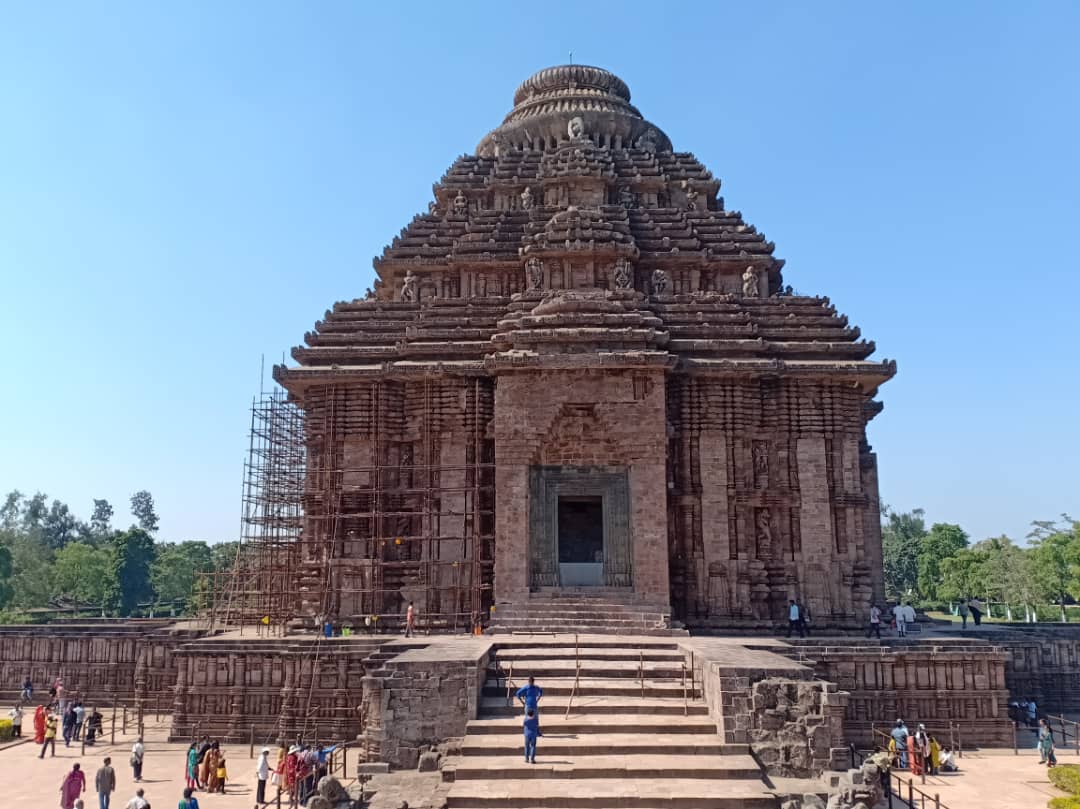
That is none other that the Konark Sun Temple, which took 1200 artisan and twelve years to built and was completed in the year 1255 AD. This temple was build under the patronage of King Narashimhadeva I of the Ganga Dynasty. 

The Konark Sun Temple

The temple was our last stop and the focus of our visit to Odisha. Since we wanted a holistic understanding of this monument we took on a government guide who spoke excellent English. We sat under a banyan tree and our guide gave us the historical context of the entire era so as to better appreciate the details to come.

The Banyan Tree

The structure of temple is designed after 24 wheeled chariot pulled by 7 horses. The Diameter of each wheel is 10 feet. The entire structure is sculptured with a wide range of artistic work.


If you were to look closely, the wheels of the chariot has 12 spokes, hence one of the wonder of this ancient monument is that, the wheels act as sundials and actually tells time based on the shadow casts on the spoke. Our guide demonstrated the process and it was really mind blowing to see the accuracy of time. 

As we moved into the complex after depositing a token into the slot that opens the barrier (similar contraption we find at metro stations), we were received by two majestic lions, pouncing on an elephant which is trampling a man, wow that looked painful.


The Inviting Lion 

The significance of this structure is that the lion represents pride and the elephant represents wealth, which together torments man. A philosophical reflection of the nature of man who is caught with inherent greed.

Conjectural Reconstruction of Konark Temple
 courtesy of Percy Brown, "Indian Architecture" 1942

The entire temple was built on a 26 acre spread, facing the sea shore. The above conjectural reconstruction gives good context to the amazing complex. The original temple constituted of a main sanctum which was estimated to be 228ft which was taller than the Tanjavur (Tanjore) Brihadheeswara temple which stood at 210ft. However that structure is in ruins now owing to various reasons.  The Sun Temple in Konark exhibits the traditional Odisha style of architecture, also known as Kalinga architecture. The temple is built with such a fine slant towards the east that the first rays of the rising sun illuminates the main entrance.  


            The Ruined Main Sanctum


The uniqueness of this temple is where the main sanctum is laid with magnetic field which allows the Sun God  idol to levitate in the centre. The construction of the main tower was done by placing iron plate between every two stone pieces. 

Iron pylons salvaged from the ruins of the main sanctum

The main lodestone at the top of the temple was said to be a massive 52 ton magnet. The Sun God idol was sculptured with iron based material which when placed at the main sanctum levitates without any physical support, due to the unique arrangements of the top magnet, the bottom magnet and the reinforced magnets around the temple walls. Unfortunately this was something that was recorded but we did not bear witness to it as this structure was destroyed by the Portuguese in the late 15th century. Reason, the magnetic field at the temple tower, messed up with their navigation and ships ran aground. 


The Jagamohana Hall (rear view)

The Jagamohana (gathering hall) stands on the same level as the main sanctum or the Deula Hall. Its roof is shaped in a three tiered pyramidal design where each tier is separated  a number of beautiful life-sized standing figures of women in various dancing poses as well as some of them posing as musicians playing different musical instruments like drums, flutes, vina and symbals, which depicts the practices of Devadashis (women who devote their entire life to temple worship).

The Jaganmohana Hall (frontal view)

Jaganmohana Hall 
(view from the Natya Hall)

The Jaganmohana hall is supposed to be a community or an audience hall for the people. However all the four entrance to the hall was sealed using stone and sand by the the order of the then Lieutenant Governor of Bengal in 1903, an exercise that took 3 years to complete. Reason, is to stop further destruction of the structure.


 Natya (Dance) Hall

The Natya Hall is the performing space for the Devadashis who carry out daily rituals of performing during aarti (main prayer). The roof of this structure has collapsed since but the base structure remain intact. Every inch of the hall is adorned  with beautiful sculptures of in variety of poses like dancing, singing, dressing, playing, cooking, romancing and fighting. Basically it tells the story of women of that time.                        

    
The view of Jaganmohana Hall from the Natya Hall

According to historical annals, the original structure ie. the main sanctum which housed the Sun God deity, had a headgear adorned with a large piece of diamond, which during sunrise, the rays passes through the Natya Hall and then trough the Community Hall at hits at the diamond, which apparently illuminates the entire inner sanctum with dazzling display of light reflection and refraction. That would have been a wonder to behold.


Intricate Carvings on the Wall

The sculpture above that adorns the wall of the Natya Hall depicts typical Devadashi's in their performance mode. 

Natya Hall 

The amazing feature of the sculpture that is found at the Konark temple is that it is divided into 3 levels. The bottom most level the sculptures depicts a person from birth to adolescent , second level depicts a family person and the third level depicts spiritual pursuits or engaging in sanyasin (ascetic).

Sculpture Depicting Life in the Palace


The Dawn of Sexuality


From The Kamasutra 


For most, if not all visitors, the depiction of sexuality in ancient monuments in India, be it Khajuraho in Madya Pradesh or Hassan in Karntaka, draws much curiosity, intrigue and even jaw dropping sight. The sexuality expressed here at Konark perhaps goes way beyond ones own imagination. The Indians seems to have thought about everything.

A maiden


The Nagas

The Nagas or serpent plays a very pivotal role in all Indian mythology, hence the sculpture of the same can be seen extensively carved in the Konark temple walls as well. The beauty of these carving are not merely on the intricacy of the work by various artisans but the fact that each of these work of art has a story behind it. 

A lotus design carved out of stone
(salvaged from the main sanctum)

This temple with all its grandeur never got consecrated because of an unfortunate event. According to popular legend 1200 sculptor headed by Bishu Maharana, were given the task to complete the construction within 12 years. However as the end of the 12th year neared the artisans faced difficulties in fitting the upper most piece of structure (known as Kalasha), much to the Kings wrath. He decreed if the artisans do not complete building the temple as intended, they will be beheaded. Fortunately for them, the 12 year old son of Bishu, Dharmapada managed to find a solution and completed the job. However despite this gesture the artisans knew that they will be still beheaded because it was they who should have finished the job and not anyone else. 

So to save themselves the the artisans asked Bishu to kill his son and hide the truth. Upon hearing this Dharmapada did not want his father to commit the sin, instead he committed suicide by jumping from the temple tower. Hence if a death occurs before a temple is consecrated, it is deemed to be a bad omen, and the temple would not proceed any further to function., an eventually the temple apparently was shut down on the orders of the King. Later the temple's Nandi (cow idol) and the flag pillar was removed from there and placed at the Puri Jeganath Temple.

Symbolic Water Vessel


The information plaque at Konark Sun Temple

Greeja and I felt deeply sad that such a gigantic and awesome temple built over a  period of 12 years just went wasted overnight. Was it human greed or ego or it could be both that brought to this state of despair. 

It was a good 3 hours of walk and talk, where guide Raju took us through a time of distant past, reliving that  moment. We were both tired but felt very elated for the sheer immersion of history that moved us in its entirety.

The Konark Temple excursion definitely aroused our gastric juices, and thence we hopped to The Sun Temple Hotel and Restaurant for a scrumptious lunch, menu recommended by Arun, our driver cum guide.


We asked for a typical Odiya menu and we definitely were not disappointed with the served cuisine. It was simply yummy and that more than whetted our hunger pangs.


The Thirsty Couple

Thus ended our tryst with Odisha. We are planning to visit Odisha in the near future, but this time it will be the south of Bhubaneshwar, to trek the hill country to meet the colourful culture of the tribals.

Last but not least I would like to thank Arun, who made our visit to Bhubaneswar even more memorable. He understood our interest and suggested places that most tourist would not know or even would have given it a miss. He shared vast information on Odiya culture, food and its people, well we even talked politics. He took us to meet his wonderful family and we enjoyed the short moment and were delighted with the hospitality rendered. 

Arun's Family

Good luck to Arun's daughters, one aspires to be a policewoman and the other wants to be a fashion designer, and to his son, still young, best wishes to him too.

Thus ended our short trip to the enchanting Odisha.

Ravi Varmman
0153
Subang Jaya
14032020