Saturday, 15 February 2020

ODISHA Travel 2

Continuing with my Odisha travel,  today, I am going to talk about the Odisha Diamond Triangle Udhayagiri, Ratnagiri and Lalitgiri. These 3 monuments stood witness to the Diamond era of Buddhism in India. We started our journey early in the morning on the 25th January 2020, from Bhubaneswar with our driver cum guide Arun, who was a fantastic company.  

  Udhayagiri Monastery

The first stop was Udhayagiri Monastery is known as the Madhavapura Mahavihara. The entire monastery complex was built using stone and bricks. The main Stupa is 7 meters (23feet) high. According to Archaeological Survey India (ASI) this monument would have been built during the 8th century. 

The Main Stupa at Udhayagiri

Below are several Buddha statues that can be found in the Udhayagiri Monastery complex site. Many of it have been destroyed owing to passing of time but others have been known to be destroyed by invaders. 

Jatamukuta Lokeswara
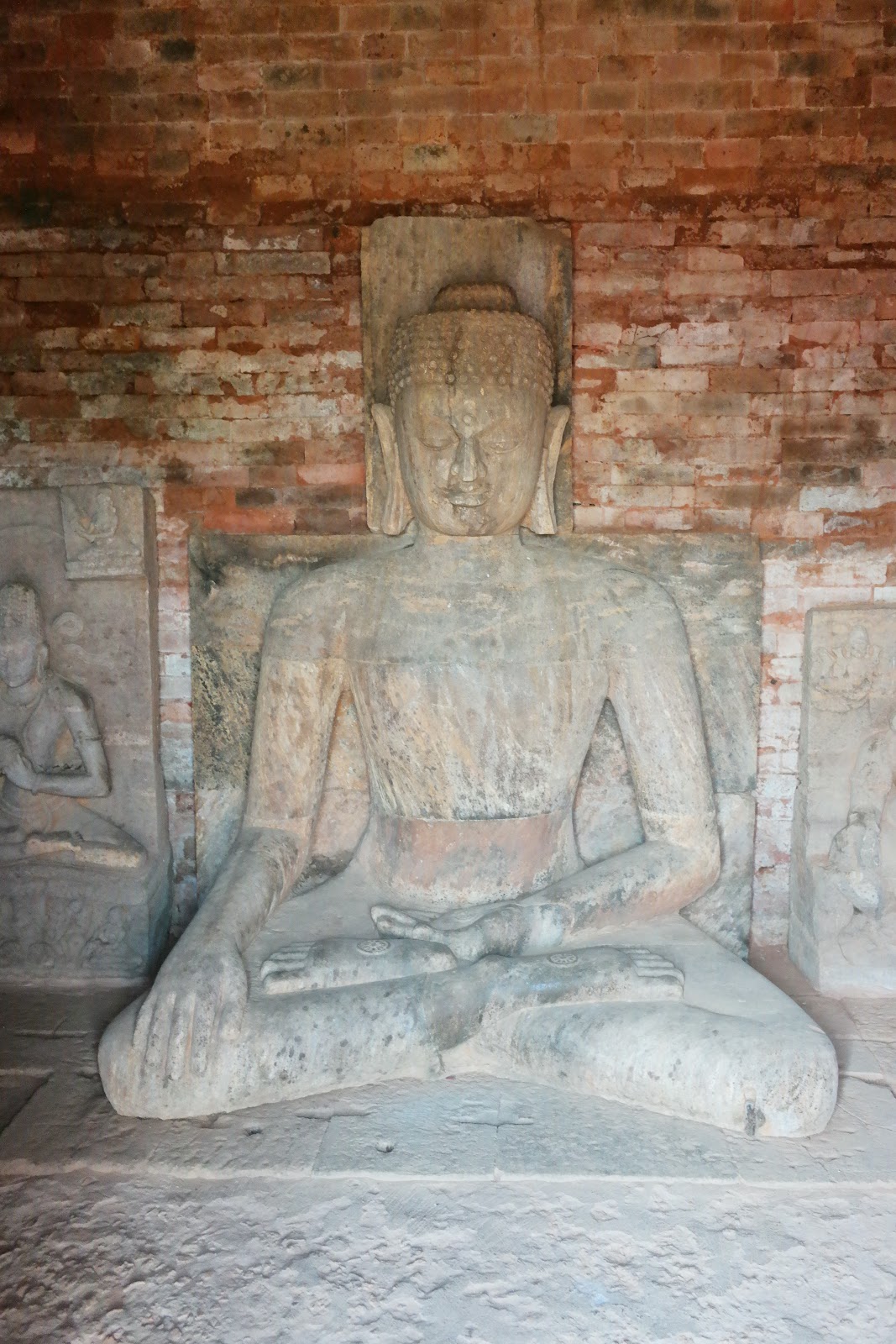
Dhyani Buddha

Avaloketisvara

Dharmachakra Buddha

Udhayagiri is also known as the Hill of the rising sun. This is also considered to be the largest excavated site by the ASI. Here there are 2 sites Udhayagiri 1 and 2. Both are within a large parameter under the administration of ASI. We had a wonderful guy who works for the ASI who volunteered to give us an insight on this archaeological site. 

Udhayagiri Site 2 Entrance to The main Stupa

A Closer look at the Stone Craving on the Main Entrance

Monastery 2 Complex

Ancient Drainage

Ruins at Udhayagiri 2
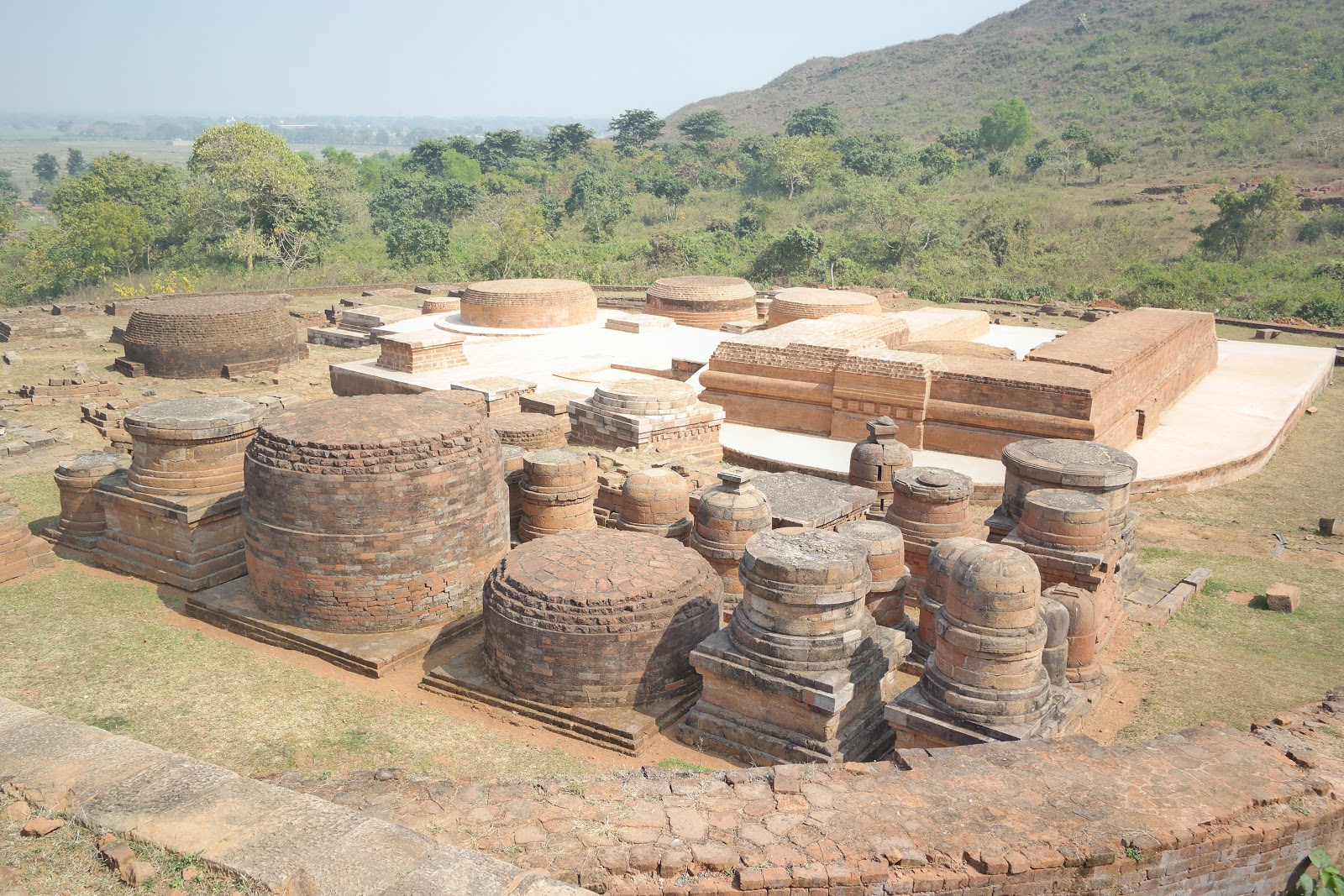
Stupas Believed To Be The Burial Place of Monks

The ASI has taken efforts to restore structures that are falling apart, so as to stabilize the said from further damage. The lighter coloured base are the restored surface.


These are rooms located within the Monastery Complex for Monks to stay and meditate

The Dhayani Buddha Located in a Brick Stupa at Udhayagiri 2

Avalokiteswara Buddha

A stone Pillar

A functional Kali Temple Located at The Udhayagiri Site

We offered our obeisance to Mahakali, said our prayers, and sought her blessings for a meaningful journey ahead. Sitting inside this ancient shrine felt very energetic and refreshing after a long track between Udhayagiri 1 and 2.

An ancient Step Well located at Udhayagiri 2

The Well.

Our next stop was at Ratnagiri, which is considered to be one of the most revered archaeological site by the ASI. Ratnagiri is also known as the Hill of Jewels. According to ASI this site was established by the Gupta Kings, including Ashoka, beginning of the 5th Century.. This particular monastery professed the Mahayana Buddhism and also played an important role in Vajrayana, or Tantric Buddhism. 

Mini Stupas at The Entry of Ratnagiri

The Main Entrance To The Monastery Complex at Ratanagiri

Statue of Pancika at The Entrance To Ratnagiri Complex


Dhyani Buddha At Ratnagiri

Vajrapani (Protector) at Ratnagiri

For the curious, JataMukuta Buddha is synonymous with Tantric Buddhism which is very much prevalent in Tibet. Interestingly many people may not know that the reference to the mystic land of Shangri La or Shambala by the Tibetans, actually denotes the city of Shambalpur in Odisha. The relationship between Tibetans and and the rich Dakshina Kosala dynasty that predates the Kalingan dynasty is mentioned in various Puranas (ancient text), including the Mahabaratha. The Dakshina Kosala kingdom fell to the Gupta Dynasty under the reign of Samudragupata circa AD350. Even Ptolemy has mentioned about Shambalaka located in the Mahanadi river, in his writings. Hence it would not be wrong to attach great importance to Ratnagiri as a centre of Buddhist teaching located at the eastern end of the Mahanadi river with the Tibetan link. 

Colossal Buddha Head

According to the 12th century Buddhist text, Chaturasiti Siddha Pravritti, it was King Indhirabhuthi who founded Vajrayana Buddhism, where the text claim that it was Buddha himself who appeared before the King who reigned Shambala of Oddiyana (or known as Ottiyan in Tamil or Ottiyam in Telegu both Dravidian language), and taught King Indhirabuthi tantric Buddhism. By virtue of that the King was also known as Mahasiddhi (or "He who has mastered all 8 Siddha knowledge*")

Further the Buddhist text also mentions that King Indhirabuthi, found a male child floating on a lotus flower, and the King brought him up as his own child and named him Padmasaambhava, who in turn was instrumental in bringing Buddhism to Tibet, Sikkim and other North Eastern territories of Bharat (pardon the use of this word, but the word India was non existent then.

Mahakala Temple at Ratnagiri

Regardless one factor is definitely archaeologically well founded, that the Buddhist Monks of the Diamond Triangle were instrumental in bringing the Vajrayana Buddhism to the North Eastern territories of Bharat.    The word Vajra means diamond or thunderbolt in Sanskrit, and it is also an instrument used in tantric rituals by the Tibetan Buddhists. Interestingly in Rig Veda (one of the Vedic scriptures) it is written that Lord Indhira uses the weapon called Vajraayutham. In all 3 traditions ie. Vedic, Buddhism and Jainism Lord Indhira appears as a significant character. Even in European traditions, similarities of Lord Indhira can be attached to Jupiter (Roman), Perun (Slavic), Perkunas (Baltic), Taranis (Celtic), Zeus (Greek) and Thor (Germanic/Norse). 

Lalitgiri 

And finally our day ended at Lalitgiri the Crimson Hill, the 3rd ancient Buddhist archaeological site in Odishsa. Lalitgiri has been found to have an unbroken Buddhist tradition from 3rd BC to 10 Century AD. 

Lalitgiri Stupas


Couldn't resist taking this picture of Cute Puppies having
an evening siesta at Lalitgiri 

Lalitgiri Stupa

The significance of this site is that, the ASI excavated 2 stone caskets with Buddha relics. Within each of the casket they found 3 boxes each made of soapstone, gold and silver, and in the gold box they found a small piece of bone, believed to be of the Buddha. The famous ancient Chinese traveler and chronicler Hsuan Tsang, has mentioned of the relics in one of his literature. The golden caskets are kept as exhibit  in a bullet proof glass casing in the newly built museum at the foot of the Monastery complex. Photography is prohibited, so couldn't get one. The ASI also believes that besides Buddha's relics, the casket also houses the bones of Sariputta and Mahamogallana, both known to be the Buddha's prominent disciples.

An Enthusiastic Couple

Thus ended our day with utmost satisfaction. For Greeja being a Buddhist, our visit to the Odisha Diamond Triangle gave her a special meaning. Stepping on this holy ground, once roamed by Kings, Monks and sundries of ancient time, gave us a phantasmagorical feel.

Will catch up soon on my next journal entry, on my trip to Odisha in Odisha Travel 3.


Ravi Varmman
21.34
Port Dickson
150122020

To the curious:
The *8 Siddha knowledge:

Anima Siddhi
The ability to become smallest in size is known as Anima Siddhi. By attaining this siddhi the practitioner can reduce one’s body even to the size of an atom or even become invisible. He becomes supernaturally strong and congenial.

Mahima Siddhi
Is the ability to expand one's body to an infinite large size. By attaining this siddhi the practitioner is able to expand the size of his body larger than the universe. He can attain the power equivalent to god who has created the universe.

Garima Siddhi
The ability to become infinitely heavy is known as Garmia siddhi. The practitioner can make himself as heavy as he desires to be and cannot be moved by anyone or anything.

Laghima Siddhi
The power to become weightless or lighter than air can be achieved from Laghima siddhi. The practitioner can become any creature on this earth and enter into his body after attaining this siddhi.

Prapti Siddhi
The ability to construct anything is known as Prapti siddhi. The practitioner can achieve anything he desired through this siddhi. There is nothing impossible for him to get such as providing water in the deserted area.

Prakamya Siddhi
Is the ability to become whatever the practitioner desires. The thoughts of the person changes drastically and experiences a flow of supernatural energies. By achieving this ability the practitioner is able to do anything he wants. He can fly in the sky or walk on the water.

Ishita Siddhi
Knowing all powers and getting a control over them is known as Ishita Siddhi. The practitioner is able to get control on all the elements of universe and possess absolute lordship. He gets the privilege to  practice lordship on anyone from states to empires. He gets converted into god himself.

Vashita Siddhi
Or Vashikaran is the ability of getting a control on life and death. With the help of this siddhi one attain control over all kinds of  living and non -living things. The one who excels in this siddhi can influence any person on this earth.


Monday, 10 February 2020

Odisha Travel 1

It was an exciting trip to Odisha or formerly known as Orissa. My fascination to Odisha circled around the Kalingan empire, followed by the Mauryan and Gupta empires. Have read the about the great Kalingan war and how Ashoka brought down this mighty empire which eventually was also the precursor for Emperor Ashoka to renounce violence and embrace Ahimsa via Buddhism. 

The Elephant Rock Where The Edict Was Carved

Hence, first on my agenda was to visit Dhauli, where this epic war took place. By 262BC the Mauryan King Ashoka's empire stretched from Baluchistan in the west to Bangladesh in the East, right up to Mysore in the south. The Kingdom of Kalinga stood n the way of his completing his expansion. Thus in the same year, Ashoka preferred war against the Kalingans, which eventually saw the death of  300,000 people, as claimed by  literature. 

Another View of The Elephant Rock

According to one account, a Buddhist monk who stood witness to this cataclysm, approached Ashoka and asked him,"King Ashoka, you have killed hundreds of thousands of people,in your quest to expand your empire, the river is flowing red with the blood fallen warriors. What did you gain by this? Would you  be able to give back the life to any of your warriors?"  

The Spot Where Once The Mighty Daya River Flowed

Apparently these words resonated deeply within Ashoka' which made him reflect and became remorseful which in turn motivated him to seek the path of Ahimsa (non violence) and upholding Dharma (cosmic law and order).

   
A View From The Dhauli Hill, Exacting The Spot Where The War Took Place

In his new avatar, Ashoka commissioned edicts to be written all over his empire renouncing violence, and promoting the Buddhist way of life. But most importantly the focus of his edicts in newly acquired territories was to build trust with the people, emphasizing just governance and the provision of equality among his subjects. 

The Edict Carved On the Stone

The edict was written in Magadhi language using the Brahmi script. Magadhi was the spoken language in the Kalingan region. Ashoka made sure that each edict was written in the local language where everyone understood its content. So therefore if one trails Ashoka's edicts all across his empire, it would have been written in different languages. Many may not know, for example Edict 13 was written both in Greek and Aramaic. Thus was Ashoka's intent, that his governance should be transparent and all his subjects should have awareness of their citizens rights. 

The Preservation of Dhauli Rock Edict

The above photo shows an enclosed area surrounding the edict, to protect it from both natural damage as well as from irresponsible visitors. Kudos to ASI (Archaeological Survey India) for keeping the entire monument and its surrounding in pristine condition.

As we drove up the Dhauligiri Hill we were welcomed by the Shanti Stupa, built between 1971-1972 by Japan Buddha Sanga with the collaboration of Kalinga Nippon Buddha Sanga and the government of Odisha. Also known as the Peace Pagoda, the entire structure is white in colour denoting peace. Four Buddha statues with different postures are placed facing four different direction. It is indeed a sight to behold.

The Shanti Stupa

Below are the four postures of Buddha that one can fine placed on the Stupa. The Dharmachakra Buddha denotes the inception of Buddhism, and the motion of the wheel of Dharma. 

Dharmachakra Buddha

The Nirvana Buddha or reclining Buddha depicts how the Buddha laid during the last few moments of is earthly life before attaining Paranirvana or ending the cycle of rebirth from his Samsara (mortal life). Note that he is depicted lying on his right side on his right arm, as it was recorded. 

Nirvana Buddha

The standing Buddha post is normally synonymous with the Buddha attaining enlightenment, Further this posture is also known as the Abhaya posture or the posture of Protection.


Abhaya Buddha

And the last posture found at the Stupa is the Dhyana Buddha, which typically depicts the days leading to the Buddhas enlightenment under the Bodhi tree. The alms bowl signifies the renunciation of the material world and its comfort.

Dhiyana Buddha

The Daya River, a view from Shanti Stupa

It was a surreal feeling looking down at the river, imagining the Kalinga War, Ashoka's repentence, and how Buddhism contributed to human thought process. 

Next to the Stupa, lies another ancient structure, the Dhavaleshwar Temple, built by the Bhauma Kara Dynasty circa 8th century CE and some scholars claim that it is contemporary to the Lingaraja Temple in Bubhaneswar (another ancient temple built by the Somavamsi Dynasty circa 11th century). Regardless this is a fully functional temple thronged by both Hindus and Buddhist alike.

The Dhavaleshwar Temple with Shanti Stupa in the Background 

Entrance To The Dhavaleshwar Temple, Guarded by 2 Lions

The Holy Basil Plant at The Entrance To The Temple

Greeja and I offered our prayers to Lord Shiva, sought his blessings for the rest of our journey in Odisha. It was indeed an experience that took awhile to sink in. Beyond the sight, it was the historical journey that we relived that made the difference.

I will continue my journal on Odisha in "Odisha Travel 2" soon.


Ravi Varmman
0628
10022020
Subang Jaya.


Sunday, 19 January 2020

PONGAL 2020


Like any other year the Tamils were celebrating the Pongal Festival, in the month of Thai of the Tamil calendar. The festival extends over 4 days, and the 2nd day would be the main event which falls on the 15th of January this year.

Preparing the Pongal Pot

In Tamil Nadu, this festival accords a long public holiday where most people will return home to their village to celebrate this festival. Malaysian Tamils who have inherited this tradition from their ancestors from India, have continued this practice since they landed in this land call Swarnabhumi.

Placing The Pongal Pot On The Fire

Hence, like in any other acculturation process, in the land now known as Malaysia, the Pongal festival was one where every ethnic community participated with a fervour of gaiety and fun. Especially in rural communities the participation was even more heightened, as the objective of this festival had a universal appeal, which is to thank mother nature that has provided for our very existence. 

Its a Thanksgiving Celebration, which goes beyond the boundaries of race and religion.

Pouring Of Milk In The Pongal Pot

Meanwhile a tear in the very fabric of this inclusive festival came in the form of a circular from the powers that be to declare that this festival is forbidden for Muslims in Malaysia to participate, as the  Islamic religious authorities deemed it to be a non Muslim religious festival. 

It brought shock not only to Malaysian Muslim's who have been participating in this festival for time immemorial but also jolted the Tamilians in Malaysia pertaining to the interpretation of the festival to be deemed to be a religious one. This whole episode threw confusion and placed many Malaysians in a dilemma. To add to further chaos, politicians, including the PM came out strong wishing Happy Pongal to everyone celebrating it.

This issue came about just as Malaysian were settling down to the controversy of Chinese New Year decoration in a secondary school, and now this has to happen.

Fortunately we still have sanity left in the very fabric of our multi ethnic society. Hussamuddin Yaacub, the chairman of Kumpulan Karangkraf, a Malay online tabloid is on mission to promote inter racial harmony and ease racial tension, by mooting a campaign called "Uninstall Hatred: Reboot Malaysia and Global Harmony."

Overflowing Of Boiling Milk Symbolizing
Abundance of Prosperity 

It is sad to see Malaysia, which was once the epitome of multiracial unity, an served as an exemplary society to the world, has degenerated to the point where even a simple seasons greetings are forbidden by certain communities.

It was not like that when I was growing up in little town called Segamat, everyone celebrated every every other festival sincerely, with a sense of brotherhood. Religious diversities nor social differences, got in the way of our bond. It was all about "respect" and "acceptance" amongst us, the word "tolerance" never arose.

Somewhere along the way, I guess people forgot the brotherhood in us, in turn, politics and economics consumed our daily life. The motto turned out, "to each it's own." It became a field day for politicians and religious bigots to cast doubts in the minds of people in order to alienate and fragmentize society for ease of control, for self serving purpose.

I believe this "bluff" will eventually seize, people in due time will see "the forest from the trees," and will wake up from this slumber, and realize that deep down, we are all the same, and we all strife for the same thing, a harmonious society with care and concern for each others well being.

I am waiting for the return of the GLORY DAYS of MALAYSIA, TANAH TUMPAH DARAHKU (the land where my blood spilled).

Cooked Sweet Rice To Be Shared With Family
And Friends In The Hope For Another 
Sweet Year Ahead with Shared
Prosperity


Ravi Varmman
18.23
Subang Jaya
19012020 


Wednesday, 1 January 2020

THE AVERTED BATTLE OF NAGADIPA


It was 523BCE, five year after Siddhartha Gautama attained Buddhahood, and through his vision he saw two royal kinsmen of the Naga Kingdom of Sri Lanka, were preparing for battle. The nephew Chulodara and his uncle Mahodara were both after the Gem Set Throne of Nagadipa. This little islet is mentioned in both Kundalakeshi and Manimekalai (both regarded as two of the oldest Tamil  Buddhist literature) as Manipallavam of Naka Nadu, present day Nainativu at the tip of the Jaffna Peninsula, Sri Lanka.

The Kiripalu Tree

Buddha was said to have presided over the warring kinsmen under this Kiripalu tree. The banyan tree next to the Kiripalu tree also bears witness to this event. The Buddha in his sermon explained about the evils of discord and the benefits of living harmoniously in peaceful coexistence. To get the warring kinsmen's attention, it was written in the Mahawamsa, that the Buddha had to perform certain miracle, where he darkened the sky with thunderous clap and then brightened it immediately after that. 

Eventually the kinsmen and the entire people of the land, paid obeisance to the Buddha and the Gem set Throne was saved from certain carnage.

The world has evolved since, no sermon alone is going to change the way people see each other. 

Conflict, according to J Krishnamurthy:

"WE join groups, we join societies hoping something good would come out of it; 
and soon we are lost in beliefs, in contentions, in ambitions, in appalling stupidities. 
It requires a great deal of understanding to break away from all this. 
No one will help us, because everybody beliefs something and has committed himself to something or other. 
Being caught in all this one grows old; then there is despair and tragedy and one accepts it as the inevitable."

What started as mere survival, humans have evolved into fragmented green eyed monsters with self centered motives. Though I am not mincing my words, at the same time I also am not denying the very existence of accepting, caring, compassionate and altruistic human beings all around us. However the former is contemptuously bedeviling the latter, stifling the very effort in creating a just society.

The Nagadipa Raja Maha Viharaya 
(The temple dedicated to Buddha at Nainativu)

Greeja and I were overwhelmed by merely being there at Nainativu, soaking in so much of significance that place had. More so, beyond the Nagadipa Raja Maha Viharaya, only about 500 meters away stands the Nagapooshini Amman Temple, an ancient Hindu temple which going on the Brahmananda Purana should predate the Buddha presence at Nainativu. Legend has it that this temple stands for universal peace, prosperity and humanity. 

The Nagapooshini Amman Temple

   The Inner Compound of The Nagapooshini Amman Temple

Both these temples are thronged by thousands of visitors of all races, religion and from all over the world. In hosting these visitors both temples in solidarity provide "annadhanam" or offering of food to temple guests. We had tasty vegetarian food served in dried banana bark, simple but it was very fulfilling. 

Food on Dried Banana Bark

This temple can't be more environmentally friendlier than this, where upon finishing our meal we are to throw our serving platter into a bin area, where the cows feast on it. It is an eco system by itself. 

The Bin Area
(look closely you could see the cows feasting)

It is the beginning of another year, the New Year Celebration is over, the fireworks have died down, to many it is back to the same old grime. Many may have pledged their own new year resolution, some may try hard, some more may even give up before they even start. But how many people would be reflecting upon themselves to be a better person. My experience at Nainativu was simply a humbling process, realizing how small a spec "i" am, and the lesson I learned was, everything starts with a "will," and taking "a" step forward in pursuit of it. 

New Year, New Vision, but the same old me, that is not going to work. 

Whether it is the egoistic Trump and Xi Jinping, the Recalcitrant Hassan Rouhani and Kim Jong Un, the Unpredictable Mahathir and Recep Erdogan, the Misunderstood Narendra Modi and Joko Widodo or even the totally lost Imran Khan and Kassym Jomart Tokayev, to name a few political leaders, who are contributors to the many uncertainty and chaos that have befell the world, they should make an effort to see humanity beyond  politics and economics, or else this malady will continue.

If only sanity prevails the world will be a better place to live. 

Do we need a miracle like the one performed by the Buddha in Nagadipa to awakened us from this materialistic slumber?

I don't know.

Let's not just "hope," instead "act" towards a better tomorrow.

Sadhu Sadhu Sadhu (Peace, Peace,Peace)
from the Kirupalu Tree


Ravi Varmman
0119
Subang Jaya
02012020 


Wednesday, 25 December 2019

15 YEARS AGO, IN HIKKADUWA, ON BOXING DAY


Greeja and I revisited Hikkaduwa and Galle after a span of 15 years just a few weeks ago. We were in Sri Lanka with our daughter Raviena on January 2004, enjoying the sun, beach and whetting our appetite with great seafood, not realizing that exactly 11 months from our visit there, the whole scenario would change. 

Christmas day 2004, I was on the couch watching TV and Greeja was in the kitchen. Suddenly I felt rather dizzy and felt the floor move under my feet. My fear was that something was happening to me,  and I called out to Greeja, and she said she was experiencing  the same dizziness. But it stopped after a while, and then they flashed on the TV saying that North West of Sumatra was hit by an earthquake.  Reports indicated that some parts of Peninsula Malaysia experienced tremors due to the earthquake. 

If the earthquake caused damage to the immediate proximity to the epicenter, it was the subsequent Tsunami that created one of the greatest destruction in the living history of mankind.  

Memorial Tomb

The above monument stands as a reminder to the wrath of nature which took away 36595 (official) lives in Sri Lanka in one fist of fury. This monument was erected above an open burial ground that houses thousands of unidentified dead persons in the aftermath of the Tsunami devastation  at Hikkaduwa. 


Marked Grave 

Greeja and I visited the Tsunami Photo Museum at Telwatta, a few kilometers from Hikkaduwa. We had the same haunting feeling as when we visited the Killing Fields in Cambodia. This was one of the few Tsunami photo museums there. Ms Kamini, a survivor of the 2004 Tsunami, ushered us around the Tsunami Museum, which actually was the site of her home before the Tsunami devastated the entire home to oblivion. She lost many of her family members and friends on that fateful Boxing Day. 

Tsunami Photo Museum


Floor Foundation

"The above floor foundation is the only thing that was left after the water resided" she said, in a deep sorrowful voice.

The Canvas Tent

And she excitedly pointed to the tethered canvas above, and exclaimed that was the tent which served as her home until proper placement took place several months later. She as many others we met are still in the state of confusion as to why this had to happen to them, I really don't know whether they have really moved on or even made peace with themselves or with their Maker on what befell them on that day.

Telwatta also witnessed the death of more than 1600 persons who were trapped in the Colombo - Galle mail train. As the train was approaching the Telwatta station,  a huge wave about 24 - 29 feet above sea level swept through the train, uprooting the train with its track, which was located approximately 200 meters from the shore line. Since it was a Full Moon holiday coupled with Christmas, the train was carrying an unusually large number of passengers, none of whom survived.

Photo of The Twisted Railway Track


The Lament of The Survivors

More Messages From Survivors

An Obituary


Below are the drawings as seen by the surviving young children who witnessed this calamity.

These pictures were drawn by Surviving Children 

During the calamity, people also witnessed certain intriguing events. Amongst which was that the entire Seenigama Muhudu Viharaya (Temple) which is located in a small island off Hikkduwa was totally spared by the Tsunami, but claiming everything on the coast adjacent to it, perhaps just about 600 meters away.

                                                                                Seenigama Vihar                                                                                                                                                                     
Another interesting thing about this temple is, the water from its well is fresh water and not salty as it should be. Lord Devol Deviyo who is the main deity at this temple believed to be the patron of fisherman. There is a story behind Lord Devol, but that we will keep it for another day.

The Fresh Water Well


The fragility of human lives can be recounted from the harrowing experiences by the people of Sri Lanka, whilst nature was displacing people on this side of the island, in the north however human recklessness was seeing the death of more than 100000 people, which eventually came to an end in 2009.

Sri Lanka, the Tear Drop of India, was also famously quoted as Serendib, Island of Dharma and also the Pearl of the Orient, had gone through it's own wretched past, but looking at the people today at Hikkaduwa, they have surely rebounded. The past is still etched in their memory but they are not allowing it to weigh them down in their pursuit to build a better tomorrow.

We left Hikkaduwa that day, quite for sometime, not really talking, but trying to take in the overwhelming stories by the locals, and wondering in amazement how life reconciles and evolves with or without people who may have mattered at different points in time.

Our existence only goes as far back as the memories of someone who still remembers us, thus there goes the insignificance of "I". All the inherited and created ego of an individual can be just washed   away in a blink of an eye, so why the self-conceit when one is alive.

Honganji Vihara

This statue of Buddha posing with the Abhaya Mudra was erected facing the sea near the site of the railway track that killed thousands on that unfortunate day. Abhaya Mudra is a gesture of fearlessness and provides reassurance and safety, which is also supposed to dispel fear and provide divine protection and bliss. Note carefully that this Buddha sculpture is based on the Bamiyan design that was destroyed in Afghanistan by the Taliban. The key message is HOPE and hence PERSEVERANCE.

This reminds me of a Tamil poem in  Purananuru, written by Kaniyan Pungundran (2nd century CE) that goes like this (translated) :

"Every village is my village and every person is from my kin.
Like a lot of things in life good and bad cannot be attributed to other as they come from within us.
Likewise, agony and relief of agony come without any external triggers but from within us.
Death is not unheard of or new.  
It unnecessary to rejoice that life is sweet or complain in anger that life is bitter.
Like rafts drifting along in the rapids of a great river, dashing over the rocks after a downpour (from skies resounding with thunder and lightning), our lives, no matter how dear, follows its own course.
We know this from the vision of wise seers who can see.
So, we are neither awestruck by the great nor do we belittle the ‘not so great."

This poem proposes the idea of equality amongst all living being, and with equanimity it can bring about peace and harmony within mankind as well as with nature.

Alas human GREED seems insatiable, more destruction is forthcoming, injustice is on the rise, not only the helpless suffer but poor mother nature is severely taking the beating. 

I trust that HOPE for a better tomorrow lies within every citizen of the world, by bringing about change to themselves first.

Today is 26 December 2019, Boxing Day, 15 years ago since the earthquake in North West Sumatra with a magnitude of 9.1 triggered a series of Tsunamis as high as 30 meters, hitting the shores of 14 countries and causing death to an estimate of 227,898 people. With one swift blow it changed the lives of many. 

So in remembering that fateful day, let us reflect and ponder on the fragility of life and what should all of us do to make the world a better place to live.


Ravi Varmman
1456
26122019
Subang Jaya